
Dear Sue,
My child understands his math when we work through it together. He can follow the steps and even explain what to do. But the moment he works on his own, everything falls apart. He makes careless mistakes, forgets steps, and sometimes gives answers that don’t make sense at all.
Is this just a lack of focus, or is something else going on? And how do I help him become more independent?
Dawn
Dear Dawn,
What you are describing is very common, and it often leaves parents feeling confused. One moment, your child seems to understand the work, and the next, it appears as if everything has fallen apart. It is tempting to think that this is a focus issue or that the child is simply being careless, but that is usually not the case.
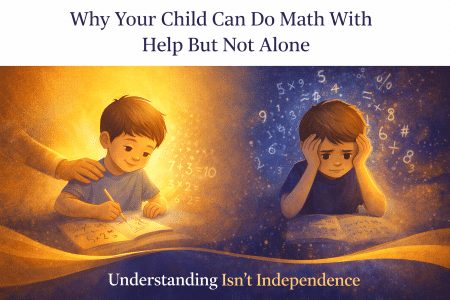
The more accurate explanation is that there is a gap between understanding the work and being able to carry it out independently. When you sit with your child, you are not only helping—you are also supporting the structure of the task. You guide the sequence of steps, keep him on track, and often correct errors before they become bigger problems. In effect, you are holding the process together.
When your child works on his own, that support disappears. He must now manage the steps, keep track of what he is doing, and monitor his own accuracy. This is where the breakdown typically occurs. The difficulty is not that he does not understand the method at all, but that the method is not yet secure enough for independent use.
For this reason, what are often described as “careless mistakes” are rarely careless in the true sense of the word. When a child skips a step, loses place value, or produces an answer that does not make sense, it usually means that something in the process was lost along the way. This can happen when the steps have not been fully learned, when too much information must be held in mind at once, or when the sequence has not yet become automatic.
It is also important to recognize that understanding a method and applying it independently are not the same thing. A child may be able to explain what to do or follow along during a guided example, but still struggle to reproduce the process correctly without support. True mastery only develops when the child can carry out the steps reliably, in the correct order, and without assistance.
In response to this situation, many parents increase practice, hoping that repetition will solve the problem. However, practice is only effective when the underlying method is already clear and stable. If the child is unsure, additional practice may simply reinforce the same errors and increase frustration.
What helps more is a structured approach to building independence. This involves reducing the number of problems, but insisting that each one is done carefully and correctly. It requires teaching a single, consistent method and ensuring that the child follows each step without skipping ahead. It also means allowing enough repetition for the process to become familiar and reliable, while gradually reducing the level of support provided.
In some cases, underlying factors such as working memory or attention may contribute to the difficulty. However, even when these are present, clear instructions, consistency, and sufficient practice remain essential. These elements provide the stability the child needs to succeed.
Independence in learning develops over time. As the steps become more secure and the process more familiar, the number of errors decreases, and the child begins to feel more confident. What once required support can then be done alone.
The goal is not only that your child understands the work when you are there to guide him, but that he can complete it accurately and confidently on his own.
Warmly,
Sue
More about Sue
Sue is an educational specialist in learning difficulties with a B.A. Honors in Psychology and a B.D. degree. Early in her career, Sue was instrumental in training over 3,000 teachers and tutors, providing them with the foundational and practical understanding to facilitate cognitive development among children who struggle to read and write. With over 30 years of research to her name, she conceptualized the Edublox teaching and learning methods that have helped thousands of children worldwide. In 2007, she opened the first Edublox reading and learning clinic; today, there are 30 clinics internationally. Sue treasures the “hero” stories of students whose self-esteem soars as their marks improve.