
When a child struggles at school, parents naturally want answers.
Why is reading so difficult? Why does writing take forever? Why do numbers seem impossible to understand? Why is learning easy for some children but so difficult for others?
For generations, children who struggled academically were often viewed as lazy, careless, or unintelligent. Today we know better. Many of these children have learning disabilities—neurologically based difficulties that interfere with the acquisition and use of specific academic skills.
A learning disability is not a sign of low intelligence. In fact, many children with learning disabilities are bright, curious, and capable. The problem is not whether they can learn. The problem is that skills others acquire with relative ease may require far greater effort and practice.
Understanding the different types of learning disabilities is the first step toward helping children receive the assistance they need to succeed.
What Is a Learning Disability?
A learning disability is a persistent difficulty in acquiring and using academic skills. The difficulty is unexpected given a person’s age, intelligence, and educational opportunities.
Learning disabilities can affect reading, writing, mathematics, language, or other important skills required for learning. They are not caused by poor teaching, lack of effort, or inadequate motivation, although these factors can influence academic performance.
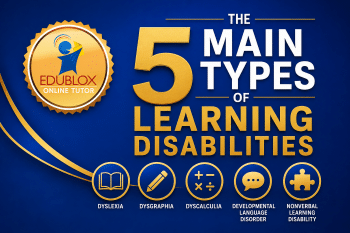
No two children are exactly alike. Even children with the same diagnosis may display very different strengths and weaknesses. Nevertheless, most learning disabilities fall into one of five broad categories.
1. Dyslexia
Dyslexia is the most common learning disability and affects the development of reading, spelling, and written language skills.
Learning to read is one of the most remarkable achievements of childhood. A child must learn to connect letters to sounds, blend those sounds into words, recognize familiar words quickly, and ultimately extract meaning from text. For children with dyslexia, this process is considerably more difficult.
Researchers have linked dyslexia to difficulties in phonological processing, rapid automatized naming (RAN), and orthographic processing. These weaknesses can make it difficult to develop orthographic mapping—the process through which written words become permanently stored for fast, automatic recognition.
Common signs include:
- Slow or inaccurate reading
- Difficulty sounding out unfamiliar words
- Difficulty remembering common sight words
- Difficulty reading aloud
- Reading that remains laborious and effortful long after peers have become fluent readers
- Avoidance of reading or frustration with reading tasks
- Poor spelling that persists despite instruction and practice
Because reading is central to most school learning, dyslexia often affects academic performance across multiple subjects.
2. Dysgraphia
Writing appears simple until we consider everything it requires.
A child must remember letter formations, spelling patterns, punctuation rules, vocabulary, sentence structure, and the ideas they wish to communicate—all while physically producing written work.
Children with dysgraphia struggle with one or more aspects of this process. Their handwriting may be slow or difficult to read. They may have trouble organizing ideas on paper. Spelling errors are often frequent, and written assignments may not reflect what the child actually knows.
Common signs include:
- Poor handwriting
- Slow writing speed
- Difficulty spacing letters and words
- Frequent spelling errors
- Difficulty organizing thoughts in writing
Many children with dysgraphia express themselves far more effectively in conversation than they do on paper.
3. Dyscalculia
For some children, numbers seem to make sense almost automatically. For others, mathematics remains confusing and frustrating despite considerable effort.
Dyscalculia affects the understanding and use of numbers and mathematical concepts. Children with dyscalculia often struggle to develop number sense—the intuitive understanding of quantities, relationships, and numerical patterns that underlies mathematical thinking.
Difficulties may begin with counting and recognizing numbers and later extend to learning math facts, understanding place value, telling time, handling money, and performing calculations.
Common signs include:
- Poor number sense
- Difficulty learning basic math facts
- Weak mental math skills
- Confusion about place value
- Frequent calculation errors
Because mathematics is cumulative, difficulties often become more noticeable as children progress through school.
4. Developmental Language Disorder
Language forms the foundation of communication, learning, and social interaction.
Children with Developmental Language Disorder (DLD) have difficulty understanding and/or using spoken language despite normal intelligence and hearing. Some struggle primarily with understanding language, while others have difficulty expressing themselves clearly. Many experience challenges in both areas.
Language difficulties can affect much more than conversation. They may interfere with following instructions, learning new vocabulary, understanding classroom explanations, reading comprehension, and written expression.
Common signs include:
- Limited vocabulary
- Difficulty following verbal instructions
- Problems finding the right words
- Difficulty understanding complex language
- Challenges participating in conversations
Because classroom learning so often depends on language, these difficulties can have far-reaching academic consequences.
5. Nonverbal Learning Disability
Nonverbal Learning Disability (NVLD) is perhaps the least well-known of the major learning disabilities.
Children with NVLD often have strong verbal abilities. They may read well, possess an extensive vocabulary, and appear highly articulate. Yet they struggle in areas that rely less on language and more on visual-spatial reasoning, organization, social understanding, and higher-order problem-solving.
This can create a confusing picture for parents and teachers. A child may sound exceptionally capable in conversation yet struggle with tasks involving maps, diagrams, patterns, social cues, or abstract reasoning.
Common signs include:
- Poor visual-spatial skills
- Difficulty understanding maps, diagrams, and charts
- Problems with organization
- Difficulty interpreting facial expressions and body language
- Challenges with higher-order reasoning
Although NVLD is not currently recognized as an official diagnosis in major diagnostic manuals, many professionals recognize the distinctive pattern of strengths and weaknesses associated with it.
Overlap and Differences
If learning disabilities came neatly packaged, life would be much easier.
A child with dyslexia would struggle only with reading. A child with dysgraphia would struggle only with writing. A child with dyscalculia would struggle only with mathematics.
Real life is seldom that tidy.
The child who cannot read fluently often struggles with spelling. A child with poor spelling may avoid writing. The child who battles with mathematics may also have difficulty understanding written word problems. One difficulty can spill into another, creating a chain reaction that affects learning across multiple subjects.
This is one reason why learning disabilities are often mistaken for one another.
The reverse is also true. Two children with the same diagnosis may look very different. One child with dyslexia may struggle primarily with decoding unfamiliar words. Another may read accurately, but so slowly that comprehension suffers. The diagnosis is the same, but the presentation is different.
Diagnoses such as dyslexia, dysgraphia, dyscalculia, developmental language disorder, and nonverbal learning disability help us identify the primary area of difficulty. They do not tell the whole story.
That is why a thorough assessment is so important. The goal is not simply to arrive at a diagnosis, but to understand the specific strengths and weaknesses that lie beneath it.
Why Diagnosis Matters
Children who struggle academically do not all need the same type of help.
A child who struggles with reading due to dyslexia requires a different intervention than a child whose difficulties stem primarily from language impairment. Likewise, a child who struggles with mathematics due to dyscalculia needs a different approach than a child whose difficulties arise from poor reading comprehension or limited language skills.
The more accurately the difficulty is identified, the more effectively the intervention can be targeted.
Understanding the nature of a child’s difficulties allows parents, teachers, and specialists to focus on the skills that require support rather than relying on trial and error.
Final Thoughts
Learning disabilities affect how a child learns, not how intelligent the child is.
Without appropriate support, learning disabilities can affect academic achievement, confidence, motivation, and a child’s overall school experience. Fortunately, our understanding of these conditions has improved dramatically over the past few decades.
Today, we know far more about the different types of learning disabilities and the challenges they create. We also know that early identification and appropriate intervention can make a meaningful difference.
The first step is understanding the difficulty. The next step is ensuring that the child receives the support needed to succeed.
Edublox provides support for students with dyslexia, dyscalculia, and other learning difficulties. We help students worldwide overcome academic challenges and reach their full potential. Book a free consultation today to discuss your child’s needs and explore how we can help them succeed.
The 5 Main Types of Learning Disabilities was authored by Sue du Plessis (B.A. Hons Psychology; B.D.), an educational specialist with 30+ years’ experience in the learning disabilities field.