

Concentration is one of the most important cognitive skills for learning. A child who struggles to concentrate may miss instructions, overlook important information, become easily distracted, and find it difficult to complete academic tasks efficiently. Without adequate concentration, even bright learners may fail to perform to their full potential.
Can concentration be improved?
Research conducted during an Edublox FUNtastic Brain Clinic in Singapore suggests that it can. An independent analysis by the Centre for Evaluation and Assessment (CEA) at the University of Pretoria found a significant improvement in concentration after just five days of intensive cognitive training.
The program was delivered to 27 students aged 10 to 12 who were preparing for Singapore’s Grade 6 examinations. These examinations play a major role in determining which high schools students may attend. A control group of 25 learners of similar age, gender, and ability continued attending school and did not participate in the program.
Students completed pre- and post-tests using a selection of Cambridge Brain Sciences assessments designed to measure memory, concentration, and reasoning abilities. Following the pre-testing phase, trained tutors presented seven to eight half-hour Edublox sessions daily over five consecutive days.
Evaluating the data
Flordis South Africa (FSA), the distributor of the cognitive-enhancing product KeenMind, sponsored the data evaluation. The Centre for Evaluation and Assessment (CEA) at the University of Pretoria’s Faculty of Education analyzed the pre- and post-test results.
One of the selected assessments was Feature Match, a Cambridge Brain Sciences test designed to measure focused attention. In this task, participants compare two similar images and identify subtle differences between them. Success depends on the ability to focus on relevant information while filtering out distractions.
Focused attention is the ability to selectively concentrate on one aspect of the environment while ignoring competing stimuli. This type of concentration is both mentally demanding and essential for learning. Children with attention difficulties, including those with ADHD, often struggle to filter out distractions and sustain attention on a single task.
Results showed significant improvement
The results showed a significant improvement in concentration after only five days of training.
The experimental group achieved a mean pre-test score of 101.85 and a post-test score of 132.52. The control group achieved a mean pre-test score of 98.80 and a post-test score of 95.04.
Table 1 presents the descriptive statistics for the experimental and control groups on the Feature Match assessment.
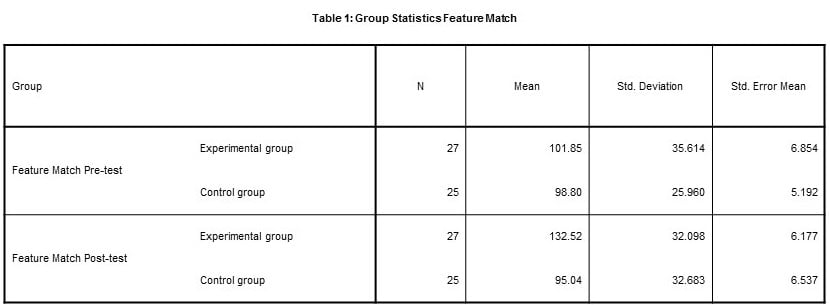
When comparing the pre-test results, researchers found no statistically significant difference between the experimental and control groups. In other words, both groups started at a similar level.
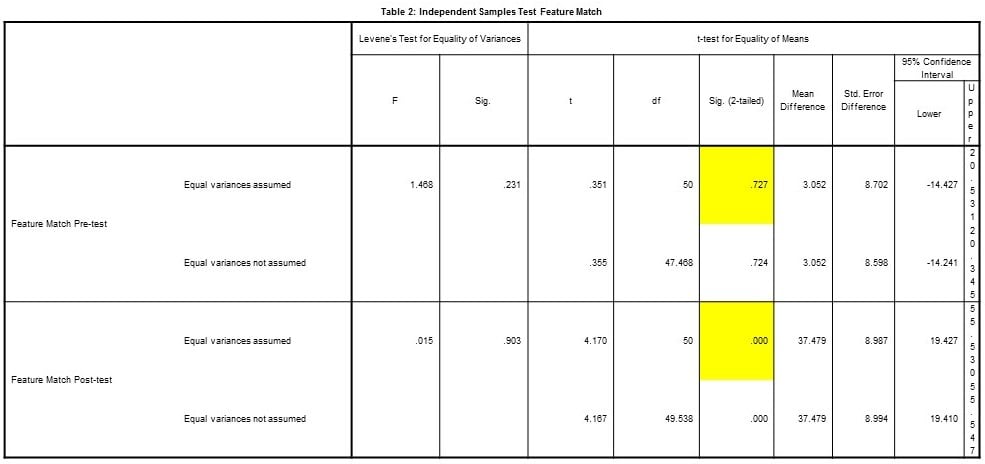
However, the post-test results revealed a very different picture. The experimental group achieved a significantly higher mean score than the control group. Statistical analysis confirmed that the difference was significant (t(50) = 4.170, p < .05).
Importantly, the effect size was large (r = .507). This value exceeds what Professor John Hattie refers to as the “hinge point” or “desired effects point” in education, indicating an educationally meaningful improvement.
Table 2 presents the statistical comparison between the experimental and control groups.
.
Why concentration matters
Concentration is one of the foundational cognitive skills that create readiness for learning. Every academic task depends on the ability to focus on relevant information while ignoring distractions.
Learners rely on concentration when listening to lessons, following instructions, reading passages, solving mathematics problems, completing assignments, and writing examinations. When concentration is weak, learning becomes more difficult because information is not processed efficiently.
For this reason, improvements in concentration can have far-reaching effects on academic performance and learning.
Conclusion
Alan Yip, founder of the academy that hosted the FUNtastic Brain Clinic, welcomed the findings.
“I am heartened to see that the FUNtastic Brain Clinic significantly improved the students’ concentration in just five days,” he said.
Yip emphasized that concentration is fundamental to learning and noted that increasing distractions in the modern environment often prevent students from performing at their full potential.
The results of this study suggest that concentration can be strengthened through targeted cognitive training. Even over a relatively short period, significant improvements were observed, providing further evidence that cognitive skills are not fixed and can be developed.