Orthographic dyslexia is a subtype of dyslexia characterized by difficulty with whole-word recognition, in particular with words that don’t sound like they are spelled. In this article, we discuss what orthographic dyslexia looks like, how it differs from other types of dyslexia, and its causes.
We specialize in helping children overcome the symptoms of orthographic dyslexia. Book a free consultation to discuss your child’s learning needs.
Table of contents:
- What is dyslexia?
- What is orthographic dyslexia?
- Signs of orthographic dyslexia
- Causes of orthographic dyslexia
- Overcoming the symptoms
- Key takeaways
What is dyslexia?
Dyslexia is a learning disability that affects how well someone reads and spells. Hallmark signs of dyslexia are trouble with decoding and persistent difficulty acquiring reading fluency. Decoding is the process of translating printed words into speech. Other symptoms are poor spelling, weak writing skills, and poor reading comprehension.
There are two broad categories of dyslexia: acquired and developmental. Acquired dyslexia occurs when a good reader and speller loses some of their reading or spelling ability due to a brain injury. Developmental dyslexia occurs when children have trouble with reading and spelling from the outset.
The terms phonological dyslexia and orthographic dyslexia describe two main types of dyslexia, which can be either acquired or developmental.
What is orthographic dyslexia?
Some people with dyslexia have trouble making sense of the sounds that make up words. These sounds are called phonemes. A child or adult whose reading difficulty stems from difficulty understanding the different phonemes in words has a weakness in phonological processing and is said to have phonological dyslexia, or dysphonetic dyslexia.
Other people with dyslexia can work with sounds but have trouble remembering what letters or words look like. Individuals who have difficulty remembering what words and letters look like have difficulty with orthographic processing and are said to have orthographic dyslexia. The term refers to the fact that this type of dyslexia often causes problems for spelling, because orthography is another term for spelling.
Synonyms are surface dyslexia, visual dyslexia, and dyseidetic dyslexia.
Signs of orthographic dyslexia
Researchers list the following signs as indicators of orthographic or surface dyslexia:
- One of the hallmarks of this type of dyslexia is frequent confusion of letter symbols that look similar but differ in orientation. Children — or adults — may thus have trouble discriminating between the letters b and d, and p and q, and are therefore prone to letter reversals.
- They might also confuse words that look alike, such as was and saw, who and how, thought and through, and young and youth.
- They may also confuse lookalike numbers, such as 2 and 5 or 17 and 71.
- They may confuse the sequence of letters in words. For instance, they might be able to remember all the letters in the word two but be unable to recall if the w or the o comes first. Sometimes, they spell the same word two or more different ways in the same piece of writing because they cannot recall how it is supposed to look.
- Children with orthographic dyslexia spell phonetically but not bizarrely, e.g., hav (have), wer (were), whith (with), onere (owner), villeg (village), spers (spears), prity (pretty), tung (tongue), cretchirs (creatures), grabed (grabbed), bildings (buildings), colect (collect), vacashun (vacation), and arkialijest (archeologist).
- Orthographic dyslexics have particular difficulty with homophones, real words that sound alike but have different spellings and meanings, such as there and their, isle and aisle, hair and hare.
- There is difficulty in reading words that are exceptions to the usual grapheme-phoneme rules, irregular words like said, what, who, one, does, and come. These words have to be recognized visually and learned specifically.
- Unlike people with phonological dyslexia, they are often good at reading new words as long as those words sound the way they are spelled. They can even sound out words like apparatus or astronomer, although they might get the accent in the wrong place or divide the syllables incorrectly.
- Spelling errors are phonologically appropriate. They might spell said as sed and thought as thot.
- They often read more slowly and make more errors when there are many words on a page.
- They might also skip lines when they read.
- They perform well on phonological awareness tests.
Causes of orthographic dyslexia
Orthographic dyslexia is not caused by poor vision and cannot be cured with eyeglasses. The problem is not with the child’s eyes but with how the child’s brain interprets the letters in words. The part of the brain that does not function well in children with orthographic dyslexia is most likely the visual word form area (VWFA).
Two separate brain regions are involved in reading: one in sounding out words and the other in seeing words as pictures.
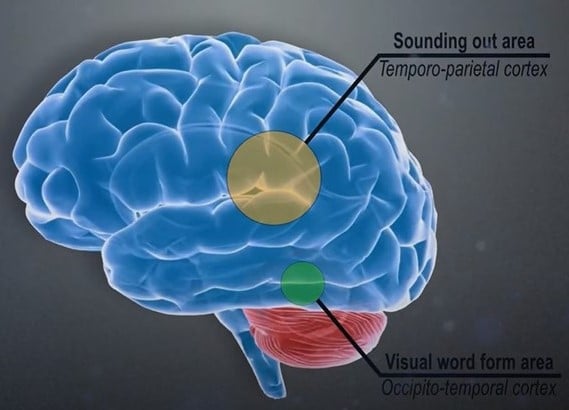
Neuroscientists at Georgetown University Medical Center (2016) concluded that skilled readers can recognize words at lightning-fast speed when reading because words are stored in a kind of visual dictionary. This part of the brain, known as the VWFA, functions separately from an area that processes the sounds of written words.
In the most extensive study of its kind, Brem et al. (2020) confirmed that the VWFA is essential to fluent reading.
The VWFA is insensitive to surface visual characteristics, such as case, font, size, and length, meaning it takes only the relevant information. For example, this area recognizes TABLE, table, tAbLe, and table as the same word. It is also insensitive to orthographic regularity (activating equally for regular and irregular words). These characteristics enable the VWFA to support effortless, automatic, and fast word recognition in literate individuals.
Notably, research by Pegado et al. (2011) shows that the ability to distinguish letter orientation, for example, to differentiate between a b and a d, is located in the VWFA.
Furthermore, while phonological processing skills are foundational to learning phonics, visual processing skills (such as spatial relations, form discrimination, and visual memory) are foundational to orthographic processing. Learning irregular words and homophones, for example, requires a good visual memory.
Another crucial foundational or cognitive skill is rapid naming, the speed with which the names of symbols (letters, numbers, colors, or pictured objects) are retrieved from long-term memory. This process is often termed rapid automatized naming (RAN), and people with dyslexia typically score poorer on RAN assessments than typical readers.
Weak cognitive skills prevent a process called orthographic mapping. Every word has three forms: its sounds, spelling, and meaning. The process of orthographic mapping involves the brain linking the three forms of the word and storing them together in long-term memory. Orthographic mapping allows for instant word recognition, fluent reading, and accurate spelling.
Developing the VWFA and improving cognitive skills such as visual processing and rapid naming should therefore be the primary targets for intervention. And that, exactly, is what Edublox does.
Overcoming the symptoms
While children do not ‘outgrow’ dyslexia, its symptoms can be overcome when visual processing deficits are addressed and the VWFA is targeted. Book a free consultation to explore how we can support your child’s learning journey.
Key takeaways
References and sources:
- Brem, S., Maurer, U., Kronbichler, M. et al. (2020). Visual word form processing deficits driven by severity of reading impairments in children with developmental dyslexia. Scientific Reports, 10.
- Georgetown University Medical Center (2016, June 9). In the brain, one area sees familiar words as pictures, another sounds out words. Retrieved July 15, 2019 from https://bit.ly/2XLzNHd
- Hultquist, A. M. (2006). An introduction to dyslexia for parents and professionals. London: Jessica Kingsley Publishers.
- Pegado, F., Nakamura, K., Cohen, L., & Dehaene, S. (2011). Breaking the symmetry: Mirror discrimination for single letters but not for pictures in the Visual Word Form Area. Neuroimage, 55, 742-749.
What Is Orthographic Dyslexia? was authored by Sue du Plessis (B.A. Hons Psychology; B.D.), a reading specialist with 30+ years of experience in the learning disabilities field.
Edublox is proud to be a member of the International Dyslexia Association (IDA), a leading organization dedicated to evidence-based research and advocacy for individuals with dyslexia and related learning difficulties.