
When parents hear the words severe dyscalculia, many fear the worst: that their child will never truly grasp numbers, never enjoy math, and never live without anxiety about schoolwork. Severe dyscalculia means more than struggling with multiplication tables — it’s when even the most basic number concepts, like place value or counting backward, remain out of reach for years.
For Robyn, a family physician, this was reality. Her daughter, Hannah, developed severe anxiety and extreme math difficulties after a strep infection triggered PANDAS (Pediatric Autoimmune Neuropsychiatric Disorders Associated with Streptococcal infections). By age 12, Hannah could count to 100, but she couldn’t count backward — and place value remained an unsolvable mystery despite six years of effort.
Today, at 15, Hannah is doing high school math confidently — and even enjoys it. This is the story of how she overcame severe dyscalculia and regained hope.
What severe dyscalculia looks like
Dyscalculia comes in different levels of severity. Some children may struggle with fractions or multiplication facts, but manage the basics. Others, however, face what can only be described as severe dyscalculia.
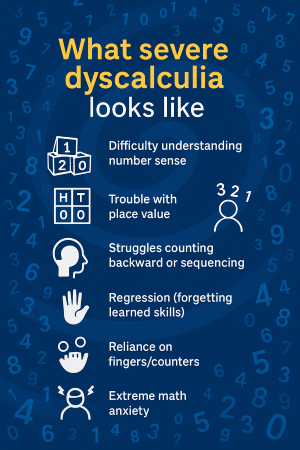
Severe dyscalculia goes beyond being “bad at math.” It affects the very foundations of number sense — the building blocks on which all later math is built. Children with severe dyscalculia may:
- Struggle to recognize number patterns or relationships (e.g., understanding that 10 is bigger than 8).
- Have difficulty counting backward or skipping numbers when counting forward.
- Fail to grasp place value, despite repeated explanations and years of practice.
- Rely heavily on concrete tools (fingers, counters, or rulers) long after peers move to mental math.
- Experience extreme math anxiety, avoiding math tasks altogether.
- Show unusual regressions, where skills that seemed learned suddenly vanish.
.
These difficulties can persist despite homeschooling efforts, curriculum changes, and even specialized teaching strategies. For parents and teachers, it can feel as if the child’s “math brain” is completely closed off.
That was Hannah’s experience. Despite her mother’s dedication and years of practice, she remained unable to grasp concepts like place value. At age 12, she could count up to 100 — but not backward. For many families, this is the heartbreaking reality of severe dyscalculia.
Hannah’s story from struggle to breakthrough
Anxiety and regression after PANDAS
Hannah’s math difficulties began early, but they became far more pronounced after a strep infection triggered PANDAS. The condition caused intense anxiety and led to noticeable regressions in her learning.
At six years old, Hannah could count, but she couldn’t do the kinds of math tasks her younger brothers managed with ease at just four. While her brothers made steady progress, Hannah seemed stuck at the very beginning of the math journey.
Schooling struggles
Determined to help her daughter, Robyn — a family physician — chose to homeschool. But despite her medical training and persistence, teaching math felt impossible. “I concluded I was a poor teacher,” Robyn admitted.
Hoping school would provide the missing piece, Robyn enrolled Hannah in primary school. Yet progress stalled there too. A teacher reassured Robyn that Hannah was “doing great,” but the reality was stark: she couldn’t even add beyond one. Discouraged, they returned to homeschooling.
Years of place value struggles
One of Hannah’s biggest challenges was place value. Robyn explained it vividly: her older son could learn in “meter lengths,” her younger son in “decimeters,” but with Hannah, she had to go down to “centimeter lengths” — and even then, the concepts wouldn’t stick.
For six long years, Robyn tried every way she could think of to teach place value. Nothing worked. By age twelve, Hannah could count up to one hundred but could not count backward — a clear sign of how deep her struggles ran.
Finding Edublox
It was around this time that Robyn discovered Edublox. After years of spending thousands of dollars on brain training programs and different math curricula, the affordability of the Edublox Development Tutor stood out.
“The cost was a big factor for me,” Robyn said. “We had already gone through multiple curriculums and brain training exercises. We’d spent thousands, and while they helped to a degree, they weren’t a panacea. The Development Tutor was fun, affordable, and game-like — a no-brainer.”
The Development Tutor strengthened Hannah’s foundation, but math was still a challenge. That’s when Robyn decided to try live tutoring.
Live tutoring and the breakthroughs
When Hannah began working with an Edublox tutor, things changed quickly.
“The tutor we had taught in millimeters, just tiny steps,” Robyn recalled. “And it was so beautiful; I would come into the other room, listen, and start crying.”
Within a month, Hannah finally understood place value — something she hadn’t been able to grasp in six years. Over the following months, her anxiety began to lift. “About six months in, she was less anxious in general,” Robyn said. “She even began to think math was fun.”
Catching up in math

The progress didn’t stop there. Over three years, Hannah caught up dramatically. From a twelve-year-old who couldn’t count backward from one hundred, she became a fifteen-year-old working confidently on high school math.
“She’s gained seven, eight years of math in three years — but knows it. Knows it solidly,” Robyn said proudly.
A mother’s perspective
Looking back, Robyn credits not just the methods, but the mindset of Edublox:
“What I love about Edublox is that they don’t give up. Even when I was thinking, ‘This isn’t going to work,’ they didn’t believe that. They believed she would get better. And they were right. There’s a snowball effect — and three years in, the results are huge.”
How to help a child with severe dyscalculia
Hannah’s journey shows that even severe dyscalculia can be overcome — but it takes the right approach. Here are key lessons from her success:
- Start with cognitive skills, not just math practice
Children with severe dyscalculia often lack the building blocks for learning: attention, working memory, sequencing, and spatial reasoning. Strengthening these through targeted cognitive training (like Edublox’s Development Tutor) lays the groundwork for math success. - Teach in tiny, incremental steps
Jumping ahead too quickly causes frustration. Hannah’s tutor broke concepts down into “millimeter steps.” Progress may look slow at first, but small wins accumulate and snowball into big breakthroughs. - Focus on place value and number sense first
These are the foundations for all other math skills. If a child doesn’t grasp place value, no amount of drill in multiplication or division will help. Place value must be mastered patiently and concretely before moving forward. - Address anxiety alongside math
Severe dyscalculia often comes with intense math anxiety. Success reduces anxiety, and reduced anxiety opens the door to more success. Build confidence through achievable tasks before introducing bigger challenges. - Choose a program that believes progress is possible
As Robyn said, what made the difference was that Edublox never gave up. Find support that sees beyond the diagnosis — where teachers or tutors genuinely believe your child can improve, no matter how severe the struggles.
FAQs about severe dyscalculia
Can severe dyscalculia be cured?
There is no quick cure for dyscalculia. However, with the right kind of cognitive training and step-by-step teaching, children can make dramatic progress — as Hannah’s story shows. Skills that once seemed impossible can become strong and reliable.
What’s the difference between mild and severe dyscalculia?
Mild dyscalculia usually shows up as difficulty with facts and procedures, such as memorizing multiplication tables. Severe dyscalculia goes deeper — children may not understand number concepts, struggle with counting backward, or fail to grasp place value even after years of practice.
How do I know if my child has severe dyscalculia?
If your child continues to struggle with very basic math skills for years despite consistent practice and quality teaching, it may be severe dyscalculia. A professional assessment can confirm this and help guide intervention.
What should parents do first if they suspect severe dyscalculia?
Start by building your child’s confidence. Choose a program that strengthens the underlying cognitive skills needed for math, rather than just repeating math drills. Early intervention is best, but improvement is possible at any age.
Can children with severe dyscalculia succeed in school?
Yes. With tailored support, patient teaching, and the right intervention, many children with severe dyscalculia can catch up to their peers, thrive in school, and even discover that math can be enjoyable.
Edublox offers an integrated approach that combines cognitive training with academic tutoring for students with dyscalculia and other learning challenges. We support families worldwide. Book a free consultation to discuss your child’s learning needs.
Severe Dyscalculia: Signs, Challenges, and a Story of Hope was authored by Sue du Plessis (B.A. Hons Psychology; B.D.), a dyscalculia specialist with 30+ years of experience in learning disabilities.