When a child struggles with reading or math, parents are often left asking: Is it dyslexia? Is it dyscalculia? Or both? In fact, many wonder whether dyscalculia is simply “math dyslexia.”
The truth is that dyslexia and dyscalculia are different learning disabilities, each with its own causes, symptoms, and challenges. At the same time, they share certain overlaps and often occur together. Understanding both their similarities and their differences is the first step to finding the right support.
This article explores dyslexia and dyscalculia side by side, explains their overlap and differences, and shares two real-life success stories — Maddie and Hannah — that show how children can thrive with proper intervention.
What is dyslexia?
Dyslexia is the most common learning disability and primarily affects the ability to read and spell. It is not a problem of intelligence or effort but a language-based learning difference with neurological roots.
Signs and symptoms of dyslexia:
- Difficulty connecting letters to sounds (phonics).
- Trouble decoding unfamiliar words.
- Slow or inaccurate reading fluency.
- Poor spelling, often with inconsistent mistakes.
- Struggles with reading comprehension, especially under time pressure.
A child with dyslexia may grasp a story when it’s read aloud, but stumble to read the very same words independently. Cognitively, dyslexia is often linked to weaknesses in phonological awareness, rapid naming, and working memory.
Beyond academics, dyslexia often causes frustration, embarrassment, and avoidance of reading activities. Children may feel “stupid” despite normal or above-normal intelligence.
What is dyscalculia?
Dyscalculia is less well known than dyslexia, but just as real. It is a specific learning disability in math that affects a child’s ability to understand numbers and mathematical concepts.
Signs and symptoms of dyscalculia:
- Weak number sense — difficulty understanding what numbers mean and how they relate.
- Place value confusion (e.g., not grasping the difference between 14 and 41).
- Difficulty counting backward or sequencing numbers.
- Trouble memorizing math facts, such as addition or multiplication tables.
- Reliance on fingers or counters persists long after peers have transitioned to mental math.
- Anxiety or panic when faced with math tasks.
Cognitively, dyscalculia is often linked to weaknesses in working memory, visual-spatial processing, and sequencing skills. Like dyslexia, it is not about effort or intelligence but how the brain processes information.
The emotional toll is significant. Many children with dyscalculia feel anxious, avoidant, and convinced they are “bad at math.”
Where dyslexia and dyscalculia overlap
Although they affect different domains — reading vs. math — dyslexia and dyscalculia do overlap in important ways:
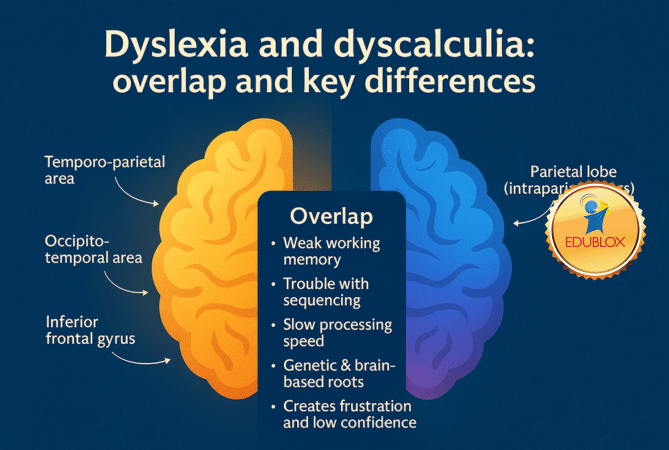
- Cognitive weaknesses: Both are often associated with weaknesses in working memory, sequencing, processing speed, and attention.
- Comorbidity: Research suggests that 20–40% of children with dyslexia also have dyscalculia. In other words, they frequently occur together.
- Genetics and neurology: Both are neurodevelopmental disorders with genetic and brain-based roots.
- Emotional impact: Both can create frustration, anxiety, avoidance, and low confidence.
- Academic consequences: Struggles in one area (reading or math) can spill over into the other, as poor comprehension or weak number sense makes all schoolwork harder.
Key differences
Despite these overlaps, it’s essential to recognize that dyslexia and dyscalculia are not the same.
| Dyslexia | Dyscalculia |
|---|---|
| Language-based learning disability | Math-based learning disability |
| Affects reading, spelling, and sometimes oral language | Affects number sense, arithmetic, and mathematical reasoning |
| Core deficit: phonological processing | Core deficit: number sense/place value |
| Brain regions: left-hemisphere reading network (temporoparietal & occipito-temporal areas). | Brain regions: parietal lobe, especially the intraparietal sulcus (number sense). |
| Daily life impact: reading, spelling, directions, writing | Daily life impact: money, time, measurement, math tasks |
| Intervention: structured literacy, phonics-based teaching, cognitive training | Intervention: step-by-step number sense building, procedural math, cognitive training |
In short, dyslexia affects how we process language, while dyscalculia affects how we process numbers.
Why accurate identification matters
Accurate diagnosis is crucial. If a child with dyscalculia is misidentified as simply having dyslexia, they may receive reading interventions when what they need is targeted math support. Conversely, children with dyslexia might be pushed harder in math when their true barrier is reading.
Without the right intervention, progress is painfully slow, and children lose confidence. When both conditions are present, both must be addressed — otherwise, gains in one area may be held back by struggles in the other.
Unfortunately, dyslexia tends to be identified earlier because reading problems are more visible, while dyscalculia is often overlooked. This makes raising awareness of dyscalculia vital.
Maddie’s story: Dyslexia and dyscalculia
Maddie faced some of the toughest challenges a student can encounter: severe dyslexia combined with dyscalculia. Reading was a constant struggle, and numbers made little sense. Progress was painfully slow despite effort, and the emotional toll was heavy.
Her family turned to Edublox after trying various approaches. Through a combination of cognitive skills training and step-by-step reading and math support, Maddie began to break through her barriers.
Over time, her reading fluency increased, her comprehension improved, and she finally started to make sense of numbers. With patience, persistence, and tailored instruction, Maddie transformed from a struggling learner into a confident student.
Her story shows that even when dyslexia and dyscalculia occur together — making the challenge double — progress is possible.
Hannah’s story: Dyscalculia alone
Hannah’s difficulties were focused on math. After a strep infection triggered PANDAS, she developed anxiety and regressed in her math learning. Despite years of effort, she couldn’t grasp place value. By age 12, she could count up to 100 but not backward, and math was a source of constant stress.
Her mother, Robyn, a family physician, discovered Edublox and enrolled her in the Development Tutor and later live tutoring. The breakthrough came quickly: within a month, Hannah finally understood place value — something she hadn’t managed in six years.
Three years later, she had gained seven years of math knowledge. At 15, she was doing high school math, confident, and even enjoying the subject she once feared.
Hannah’s story proves that dyscalculia symptoms, even when they seem entrenched, can be overcome with the proper intervention.
Lessons from Maddie and Hannah
Together, Maddie and Hannah’s journeys teach us important lessons:
- Dyslexia and dyscalculia can appear together or separately.
- Both require specialized interventions targeting their unique challenges.
- Strengthening cognitive foundations — like memory, attention, and sequencing — is key.
- Small, incremental steps lead to major breakthroughs.
- Most importantly: with the right support, progress is possible, no matter how hopeless it feels at the start.
Conclusion
Dyslexia and dyscalculia are distinct but overlapping learning disabilities. Dyslexia affects language, dyscalculia affects math — but both can hold children back and impact their confidence. Accurate identification and targeted intervention make all the difference.
Maddie and Hannah’s stories remind us that no matter the challenge, there is always hope. With patient teaching, cognitive training, and belief in a child’s potential, barriers can be overcome.
If your child struggles with reading, math, or both, Edublox offers research-based programs that address the root causes and build skills step by step. Progress is possible — and stories like Maddie’s and Hannah’s prove it.
Edublox offers an integrated approach that combines cognitive training with academic tutoring for students with dyscalculia, dyslexia, and other learning challenges. We support families worldwide. Book a free consultation to discuss your child’s learning needs.
Authored by Sue du Plessis (B.A. Hons Psychology; B.D.), a dyslexia and dyscalculia specialist with 30+ years of experience in learning disabilities.
Edublox is proud to be a member of the International Dyslexia Association (IDA), a leading organization dedicated to evidence-based research and advocacy for individuals with dyslexia and related learning difficulties.