
People often ask how Edublox got involved in dyscalculia. The truth is, it all began with two students — Maddie and Hannah — whose struggles with numbers reshaped how we approached math learning forever.
When Maddie first came to Edublox, she had severe dyslexia and dyscalculia. Back then, our math program was still basic, and we quickly realized it wasn’t enough.
That’s when it hit us: the same learning principles that help a child read also apply to math. Principles don’t change because the content does.
Then came Hannah — a student with severe dyscalculia. It was through working with these two that Edublox’s unique math intervention began to take shape.
Maddie’s story: From struggling to “most improved”
Maddie presented with severe dyslexia and dyscalculia. Despite consistent efforts, traditional practices weren’t moving the needle.
We focused on strengthening underlying skills — visual processing, sequencing, and working memory — while teaching procedures clearly and cumulatively. With consistent cognitive and math training, things began to change.
Within months, her confidence grew — and with it, her performance.
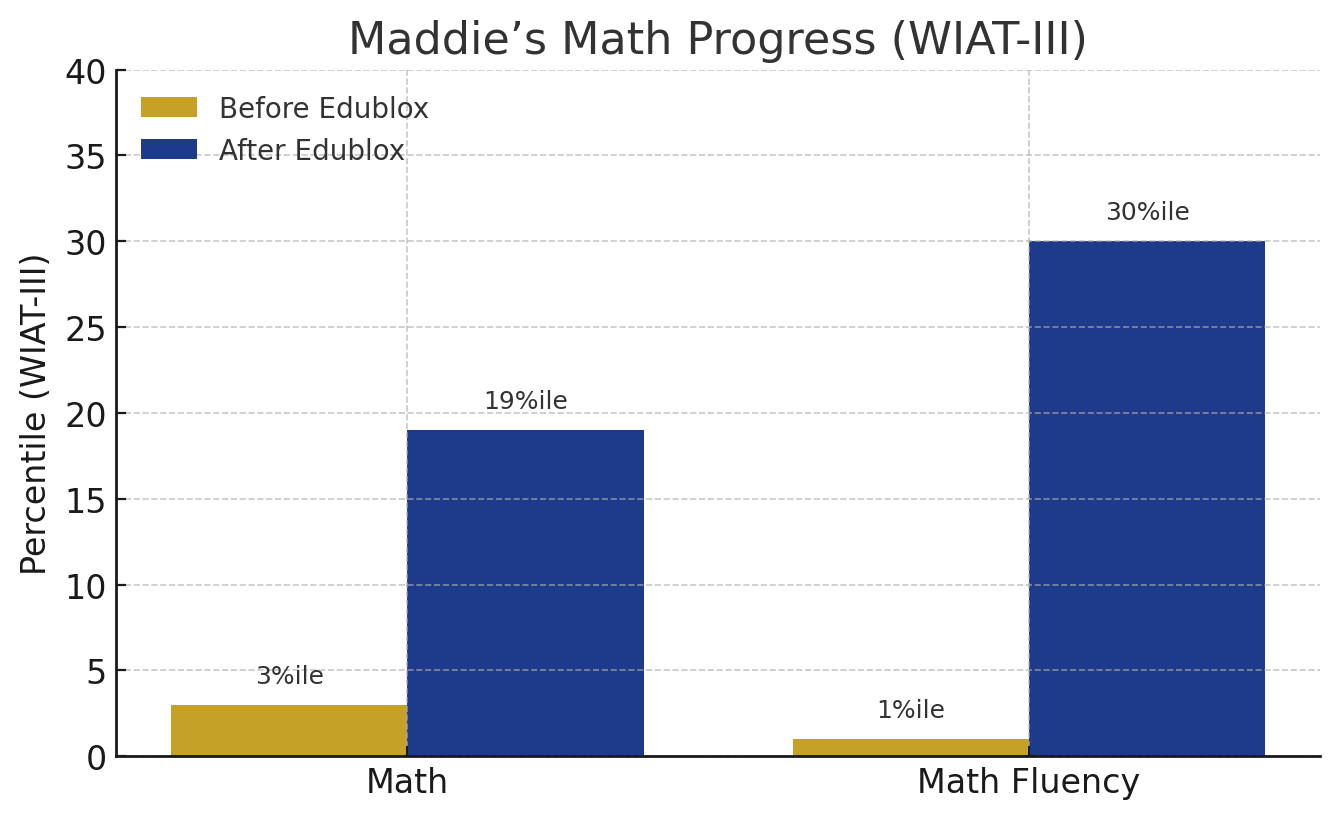
Her WIAT-III scores showed dramatic growth, according to her psychologist:
- Math: Maddie improved from the 3rd percentile to the 19th percentile
- Math Fluency: She improved from the 1st percentile to the 30th percentile
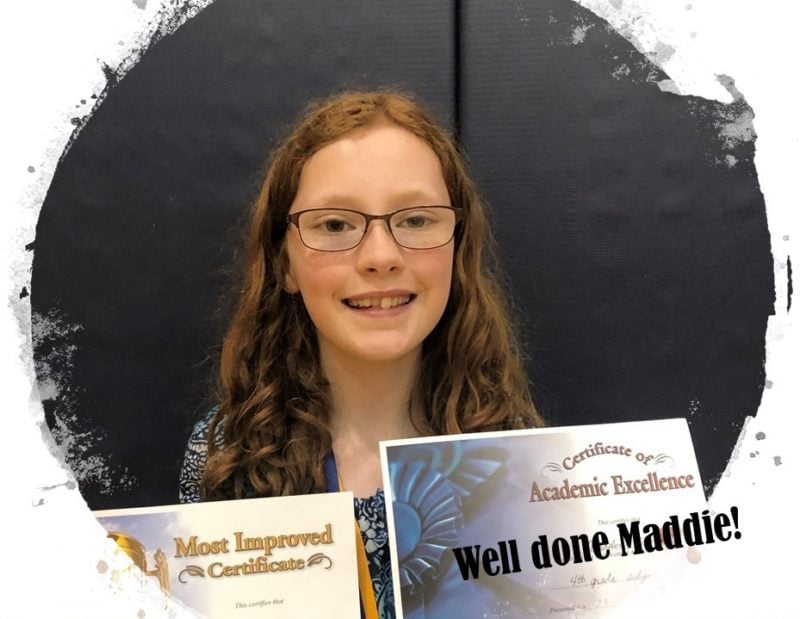
Her school awarded her the “Most Improved in Math” certificate. And perhaps even more importantly, she began to see herself differently — not as a struggler, but as a learner who could succeed.
Hannah’s story: Seven years gained in three years
Hannah’s challenges were compounded by a post-infectious condition known as PANDAS, which left her with severe cognitive and math learning difficulties. But with time, patience, and targeted intervention, the results were remarkable.
Her mother later said:
“As a 15-year-old, she gained 7–8 years of math in three years — and she knows it solidly.”
That statement captures more than numbers on a page — it captures transformation. When underlying cognitive skills improve, learning shifts from memorization to mastery.
The lesson: Principles don’t change
What Maddie and Hannah taught us was profound: the same learning principles that transform struggling readers can also transform struggling math learners.
When we began applying Edublox’s core teaching principles to math, the results spoke for themselves. These principles guide how children learn, not merely what they learn. A few examples include:
- We teach in a step-by-step manner. Learning is a cumulative process. Every bit of knowledge depends on something that came before it. A child can’t subtract without first being able to count backward — just as they can’t read words without recognizing letters and sounds. This is why Edublox teaches in carefully sequenced steps, ensuring that each level of understanding becomes the foundation for the next.
. - We build a “pyramid of repetition.” Inspired by the work of Japanese educator Shinichi Suzuki, this principle acknowledges that beginners require intensive repetition initially. Over time, as skills strengthen, less repetition is needed for mastery. At Edublox, we use this “pyramid of repetition” to solidify both brain-based foundational skills and academic skills, ensuring that learning becomes faster and more automatic.
These are just two of the nine principles that underlie the Edublox method — principles that apply across subjects, abilities, and even diagnoses. When they are applied to math, something remarkable happens: children who once felt lost begin to see patterns, relationships, and meaning in numbers.