

Hello Sue,
We market screening products to schools, and a few years ago, we added a visual fluency test to our school screening battery. In this task, the student is shown a target shape at the top and must click on it from a row of shapes below, as soon as the target appears.
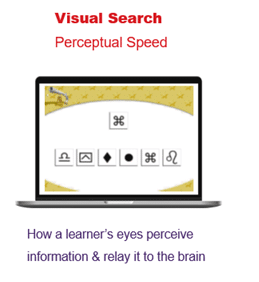
We’ve noticed a surprising number of students being flagged by this test, and unfortunately, we don’t have a proven remediation program to recommend for visual fluency issues.
What’s particularly interesting is that many of the students who struggle here are often suspected of being dyslexic. They show a significant gap between oral and reading comprehension, test well on phonemic awareness, and are decent at decoding. Still, they tend to be weak in encoding and score poorly on this visual fluency task.
Do you have anything on your end that might help?
Brian
Hello Brian,
While “visual fluency” isn’t always precisely defined, it overlaps significantly with visual processing, spatial awareness, visual memory, and processing speed.
The test you’re using closely resembles elements of Marianne Frostig’s Developmental Test of Visual Perception—a reminder that, in education, old ideas are often repackaged under new names.
It also closely resembles the Feature Match test, which is often used to assess focused attention and taps into visual discrimination and visual processing speed. These are areas where we’ve seen significant improvement with Edublox. In fact, one study reported measurable gains in attention and visual discrimination after just five days of intensive Edublox training.
In another study, conducted by J. Mays, the Visual Memory subtest from the TVPS-3 was used to measure progress. After just 22.5 hours of intensive Edublox training, students improved by an average of 1.3 years in visual memory age.
The Visual Memory subtest (part of the TVPS-3) is similar in format to your test, though it relies on memory rather than immediate recognition.
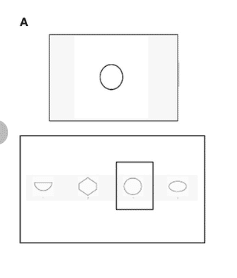
A more recent study found that Edublox also improves processing speed—another key factor in learning efficiency.
Children with dyslexia who are strong in phonemic awareness but weak in visual perception typically have what we call orthographic dyslexia. This is a specific form of dyslexia that refers to individuals who struggle with orthographic processing—the ability to form, retain, and recall visual word representations needed for fluent reading and accurate spelling.
Visual processing skills underpin orthographic processing, which is why this test identifies some students despite strong phonemic awareness.
Kind regards
Sue
More about Sue
Sue is an educational specialist in learning difficulties with a B.A. Honors in Psychology and a B.D. degree. Early in her career, Sue was instrumental in training over 3,000 teachers and tutors, providing them with the foundational and practical understanding to facilitate cognitive development among children who struggle to read and write. With over 30 years of research to her name, she conceptualized the Edublox teaching and learning methods that have helped thousands of children worldwide. In 2007, she opened the first Edublox reading and learning clinic; today, there are 30 clinics internationally. Sue treasures the “hero” stories of students whose self-esteem soars as their marks improve.