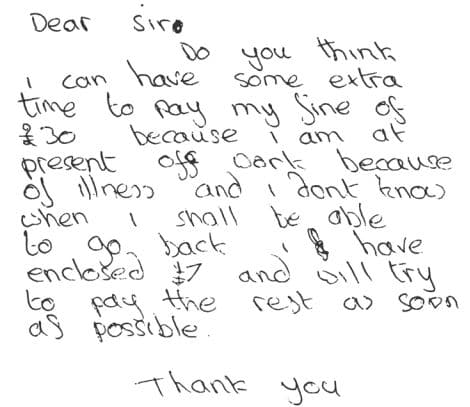
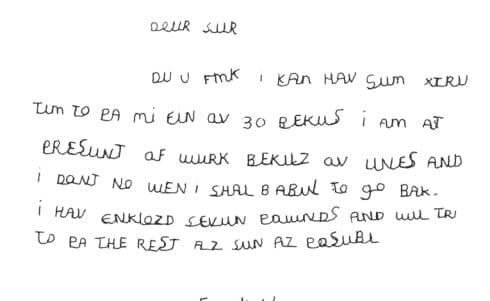
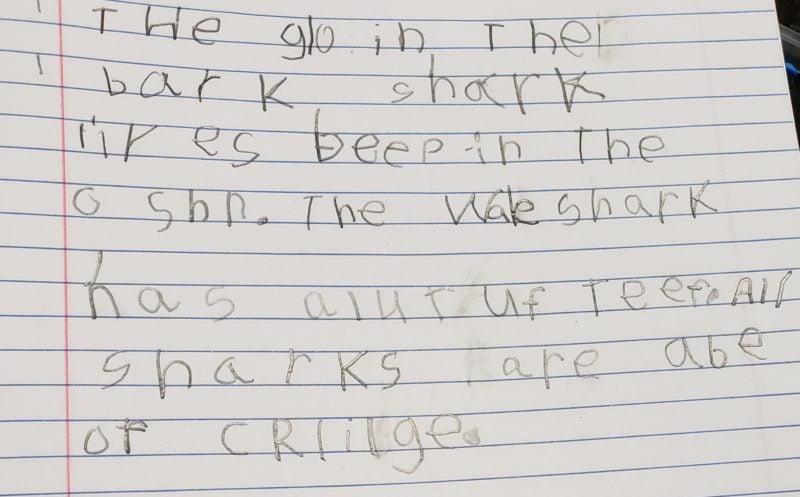
bear momee I canot reed plees help. Davib.
David is not a slow learner. In fact, according to the evaluations of several professionals, he is rather intelligent. Yet he certainly has a problem and shares it with millions of other children and adults.
David has dyslexia.
Dyslexia is a severe reading difficulty not caused by any profound sensory, neurological and intellectual disorders or sociocultural factors. Depending on the definition and diagnostic criteria employed, dyslexia affects 3% to 20% of the population. Up to 40% of people experience reading difficulties. As with most disorders, dyslexia occurs on a continuum, varying from mild to severe, and there are many dyslexia types.
Table of contents:
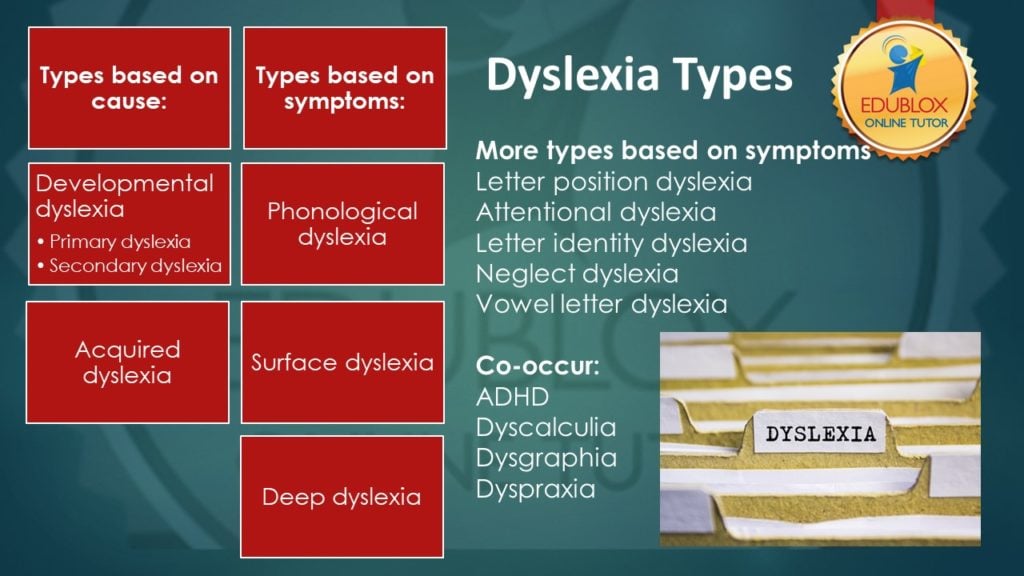
- Dyslexia types based on causes
- Dyslexia types based on symptoms
- More dyslexia types, researchers say
- Other important concepts
- Specialized help for different dyslexia types
- Key takeaways
Dyslexia types based on causes
1. Primary dyslexia
Clinicians have known for a long time that dyslexia runs in families, which means a child with a parent with dyslexia is likelier to have the learning difficulty themselves. Primary dyslexia refers to dyslexia when it is the result of a genetically inherited condition.
2. Secondary dyslexia
Secondary dyslexia refers to reading difficulties caused by problems with brain development during the early stages of fetal development. Note that both primary and secondary dyslexia are considered developmental.
3. Developmental dyslexia
The term developmental dyslexia refers to an unexpected difficulty in reading in children and adults who otherwise possess the intelligence, motivation, and schooling considered necessary for accurate and fluent reading. Developmental dyslexia distinguishes the problem in children and youth from similar issues experienced by persons after severe head injuries.
4. Acquired dyslexia
When an adult or child has a brain injury from trauma or disease, they can sometimes develop difficulties with language processing, which may result in dyslexia. This type of dyslexia is referred to as acquired or trauma dyslexia.
Dyslexia types based on symptoms
The terms phonological dyslexia and surface dyslexia are generally used to describe two main types of dyslexia. Synonyms for phonological dyslexia are dysphonetic dyslexia and auditory dyslexia. Synonyms for surface dyslexia are dyseidetic dyslexia and orthographic dyslexia. Deep dyslexia is sometimes used to describe a severe impairment.
5. Phonological dyslexia
Phonological dyslexia is rooted in a deficit in phonological awareness—the ability to recognize and manipulate the individual sounds in spoken words. This includes difficulties with identifying, segmenting, blending, and rearranging phonemes.
This type of dyslexia often presents as trouble breaking words into syllables and smaller sound units called phonemes. For example, if you say a word out loud to a child with weak phonemic skills, he can hear the word just fine and repeat it back to you. But he’ll have trouble telling you how to split it apart into the different sounds that make up the word. Difficulties in this area can make it challenging for readers to match phonemes with their written symbols (graphemes), which makes it hard to sound out or “decode” words.
Children are often tested for issues in these areas by being asked to read pseudowords, like jeet. The idea is to show kids a word they’ve never come across before and see if they can sound it out.
Smith (1991) lists other reading and spelling patterns of children with phonological dyslexia:
- Poor ability to remember individual sounds or sequences of sounds.
- Difficulty blending individual sounds into words.
- Difficulty listening to words and omitting one sound and substituting it for another (say cat; now take off the /c/ and put on an /f/).
- Difficulty remembering the sounds that individual letters and phonetically regular and irregular letter combinations represent.
- Difficulty analyzing unknown words because of poor knowledge of phonetic rules and difficulty sequencing sounds.
- Vowel sounds are particularly troublesome.
- Guessing at unfamiliar words rather than employing word-analysis skills.
- Spelling remains below reading level because it is attempted by sight rather than by ear.
- Correct spellings occur primarily on words the child has encountered repeatedly and, therefore, can revisualize.
- Bizarre spellings that are seldom identifiable, even by the child, because they do not follow phonetic patterns.
- Extraneous letters and omitted syllables in spelling.
.
6. Surface dyslexia
This type of dyslexia refers to kids who struggle with reading because they cannot recognize words by sight. Sight-reading is an essential skill for a couple of reasons. One is that some words have tricky spellings. For example, words like weight and debt cannot be sounded out — readers need to memorize them. The other reason has to do with reading fluency. To read quickly and accurately, kids need to recognize many common words at a glance — without sounding them out (Newcombe & Marshall, chap. 2, 2017).
Children with surface dyslexia also show weaknesses in rapid automatized naming (RAN)—how quickly they can name familiar symbols such as letters, numbers, or colors. Poor RAN skills can limit the ability to build a large sight word vocabulary, making reading slower and less fluent.
Smith (1991) lists other reading and spelling patterns of children with surface dyslexia:
- Confusion with letters that differ in orientation (b-d, p-q).
- Confusion with words that can be dynamically reversed (was-saw).
- Very limited sight vocabulary; few words are instantly recognized from their whole configuration — they need to be sounded out laboriously, as though being seen for the first time.
- Losing the place because one doesn’t instantly recognize what had already been read, as when switching one’s gaze from the right side of one line to the left side of the following line.
- Omitting letters and words because they weren’t visually noted.
- Masking the image of one letter by moving the eye too rapidly to the subsequent letter may result in the omission of the first letter.
- Difficulty with rapid retrieval of words due to visual retrieval weaknesses.
- Visual stimuli in reading prove so confusing that it is easier for the child to learn to read by first spelling the words orally and then putting them in print.
- Insertions, omissions, and substitutions when the passage’s meaning guides reading.
- Difficulty recalling the shape of a letter when writing.
- Spells phonetically but not bizarrely (laf-laugh; bisnis-business).
- Can spell difficult phonetic words but not simple irregular words.
.
7. Deep dyslexia
Deep dyslexia is used to describe a severe form of dyslexia. It is accompanied by semantic errors (e.g., street is read as road), but also visual errors (e.g., badge is read as bandage), derivational errors (e.g., edition is read as editor), and difficulty reading functional words (e.g., as, the, so). Deep dyslexia is often described as an acquired reading disorder due to a brain injury (Mather & Wendling, 2012).
.
More dyslexia types, researchers say
In their article “Types of developmental dyslexia,” Friedmann and Coltheart (2018) discuss phonological dyslexia and deep dyslexia. They distinguish between surface and visual dyslexia, which is generally used synonymously. They also list five other types of dyslexia:
8. Letter position dyslexia
Individuals with a deficit in this function can identify the letters correctly but fail to encode the order of the letters within the word. This dyslexia type is called letter position dyslexia (LPD), and its cardinal symptom is the migrations of letters within words. Thus, words like cloud can be read as could, fried as fired, and dairy as diary. Another related error that individuals with LPD make is the omission of doubled letters: for example, they may read drivers as divers, and baby as bay.
9. Attentional dyslexia
In attentional dyslexia, letters migrate between neighboring words but are correctly identified and keep their original relative position within the word. For example, the word pair cane love can be read as lane love or even lane cove.
10. Letter identity dyslexia
Letter identity dyslexia (LID) is a deficit in the orthographic-visual analysis, in the function responsible for creating abstract letter identities. It is not a visual deficit, as readers with this dyslexia can still match similar non-orthographic forms, visually match two instances of the same letter in different sizes, and copy letters correctly. However, readers with LID cannot access the abstract identity of letters from their visual form, so they cannot name a letter, identify a written letter according to its name or sound, or match letters in different cases (e.g., A and a) or fonts.
11. Neglect dyslexia
A condition in which a person is unaware of half of the visual field due to neurological damage. Either the initial parts of words are misread (left neglect), or the terminal parts of words are misread (right neglect). These errors are not simple deletions but typically guesses of actual though incorrect words with approximately the correct number of letters. The person with neglect dyslexia may read blend as lend and shown as show.
12. Vowel letter dyslexia
Individuals with vowel dyslexia omit, substitute, transpose, and add vowel letters. Thus, the word bit can be read as bat, but, or even boat.
Some scholars say that research does not support using dyslexia subtypes to guide assessment and intervention (Peterson et al., 2014).
.
Other important concepts
Double deficit
You may also hear some people use the phrase double deficit. A double deficit refers to kids who struggle with both phonological awareness and rapid automatized naming (RAN)—two core difficulties linked to phonological and surface dyslexia, respectively.
Some experts think slow naming speed reflects difficulties with phonological processing in reading. However, Landerl et al. (2018) examined 1,120 children learning one of five writing systems with different degrees of orthographic complexity (English, French, German, Dutch, and Greek). While RAN was a universal predictor of reading in all five languages, no consistent pattern appeared for the phonological awareness–reading relationship. The researchers conclude that phonological awareness’s direct contribution to reading development might be less causal than is generally assumed.
Overall, processing speed seems to play a role in rapid naming.
Dyslexia may co-occur with other learning disorders
Dyslexia may co-occur with other developmental disorders, such as attention deficit hyperactivity disorder (ADHD), dyscalculia, dysgraphia, or dyspraxia (Wydell & Fern-Pollak, 2012).
Dyscalculia, which means inability to calculate, is the most widely used term for disabilities in arithmetic and mathematics.
Dysgraphia refers to a specific set of writing challenges that impacts writing skills like handwriting and spelling.
Dyspraxia also goes by the name “clumsy child syndrome.” If your child has dyspraxia, they have trouble planning and coordinating their body movements and struggles with fine-motor tasks like writing, buttoning his clothes, and tying their shoelaces. Additionally, they may have difficulty coordinating their facial muscles to produce sounds, resulting in garbled speech. Their gross-motor coordination may be weak, too, so they are conspicuously clumsy and weak at sports.
.
Specialized help for different dyslexia types
Edublox combines research and evidence-based reading instruction with cognitive training to address the multiple challenges associated with dyslexia. Our programs target the foundational skills required for learning—such as attention, memory, processing speed, and sequencing—while also building literacy skills like decoding, fluency, spelling, and comprehension.
We understand that dyslexia is not a one-size-fits-all condition. That’s why Edublox’s approach is personalized, addressing both the symptoms and the underlying causes of reading difficulties. We offer targeted help for the many types of dyslexia—rooted in science, tailored to your child.
Explore our customer reviews to see how Edublox tutoring makes a difference (watch our playlist) and book a free consultation to discuss your child’s needs.
.
Dyslexia types – Key takeways
References for What Are the 12 Types of Dyslexia?
- Friedmann, N., & Coltheart, M. (2018). Types of developmental dyslexia. In A. Bar-On & D. Ravid (Eds.), Handbook of Communication Disorders (pp. 241–259). De Gruyter Mouton.
- Landerl, K., Ramus, F., Moll, K., Lyytinen, H., Leppänen, P. H., Lohvansuu, K., … & Schulte-Körne, G. (2018). Predictors of developmental dyslexia in European orthographies with varying complexity. Journal of Child Psychology and Psychiatry, 60(6), 686–697.
- Mather, N., & Wendling, B. J. (2012). Essentials of Dyslexia Assessment and Intervention. Wiley.
- Newcombe, F., & Marshall, J. C. (2017). Reading and writing by letter sounds. In K. Patterson, J. Marshall, & M. Coltheart (Eds.), Surface Dyslexia: Neurological and Cognitive Studies of Phonological Reading. Hillsdale, NJ: Lawrence Erlbaum.
- Peterson, R. L., Pennington, B. F., & Olson, R. K. (2014). Subtypes of developmental dyslexia: Testing the predictions of the dual-route and connectionist frameworks. Cognition, 126(1), 20–38.
- Smith, C. R. (1991). Learning Disabilities: The Interaction of Learner, Task, and Setting. Allyn & Bacon.
- Wydell, T. N., & Fern-Pollak, L. (2012). Neuroimaging of developmental dyslexia: A psycholinguistic perspective. In J. Fawcett (Ed.), Dyslexia in Context: Research, Policy and Practice (pp. 78–93). Whurr Publishers.
What Are the 12 Types of Dyslexia? was authored by Sue du Plessis (B.A. Hons Psychology; B.D.), a dyslexia specialist with 30+ years of experience in the learning disabilities field. Medically reviewed by Dr. Zelda Strydom (MBChB). Updated on July 8, 2025.
Edublox is proud to be a member of the International Dyslexia Association (IDA), a leading organization dedicated to evidence-based research and advocacy for individuals with dyslexia and related learning difficulties.