
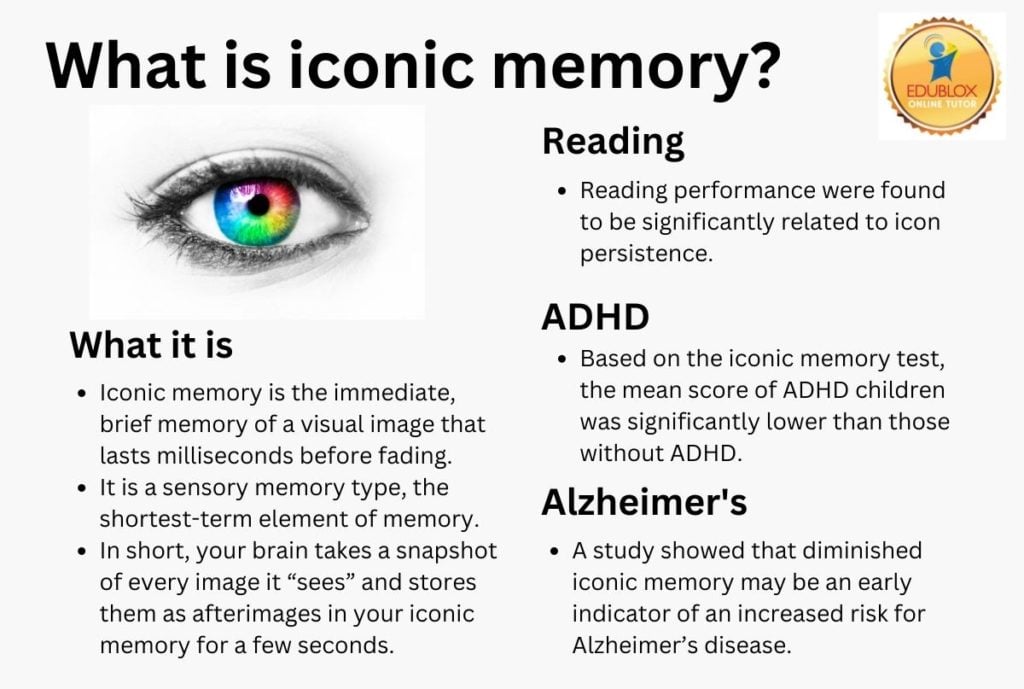
Iconic memory is the immediate, brief memory of a visual image that lasts only a fraction of a second before fading. It is a type of sensory memory—the shortest-term element of the memory system.
Sensory memory acts as a buffer for stimuli received through the five senses: sight, hearing, smell, taste, and touch. These inputs are accurately retained for only a very brief period. For example, the ability to momentarily recall what something looked or sounded like after just a second of observation is an example of sensory memory.
The sensory memory for visual stimuli is called iconic memory. For aural stimuli, it is known as echoic memory; for taste, gustatory memory; for smell, olfactory memory; and for touch, haptic memory. Echoic memory lasts two to four seconds, whereas iconic memory fades after only a few hundred milliseconds.
Iconic memory is part of the visual memory system, which also includes visual short-term memory and visual long-term memory. It serves as the first stage in visual memory processing. Information that is attended to can move into visual short-term memory, where it can be held for several seconds, and eventually into visual long-term memory, where it can be stored indefinitely.
Examples of iconic memory
We encounter iconic memory constantly in everyday life, often without realizing it. These fleeting visual impressions help us process the world, even when we catch only a glimpse. Below are a few common examples that illustrate how iconic memory works in real situations.
- At night, you get up to have a drink of water and turn on the kitchen light. Almost instantly, the bulb burns out and leaves you in darkness—but you can briefly recall what the room looked like from the glimpse you managed to get (Cherry, 2023).
- Two girls are playing hide and seek. One of them, hiding in a closet, hears the other walking by. She jumps out and screams before diving back into the closet. The image of the girl jumping out becomes an iconic memory in the mind of the second girl (YourDictionary Staff, 2022).
- You are driving on the highway when you pass a large billboard. Your brief memory of what you saw on the billboard is an example of iconic memory (Perera, 2025).
In other words, your brain takes a mental snapshot of every image it sees and stores these visual impressions in iconic memory for only a fraction of a second.
A brief history of iconic memory
The roots of iconic memory can be traced back to ancient philosophy. Aristotle was among the first to observe and describe the persistence of a visual image after the object itself had disappeared. He even suggested that dreaming might involve such afterimages—brief traces of what the eyes had once seen (Allen, 1926).
Centuries later, during the eighteenth and nineteenth centuries, scientists became fascinated by the trail of light left by a glowing ember as it was swung through the air in darkness. This effect, known as visible persistence, prompted early investigations into how and why the eye retains visual information for a brief moment after a stimulus disappears (Coltheart, 1980).
A major breakthrough came in 1960 when American cognitive psychologist George Sperling conducted a series of experiments to investigate this fleeting form of memory. His studies revealed that people could temporarily retain a large amount of visual information—more than they could report—suggesting the existence of a brief, high-capacity visual memory store. He demonstrated that both capacity and duration were important characteristics of visual sensory memory (Sperling, 1960).
In 1967, cognitive psychologist Ulric Neisser introduced the term iconic memory to describe this rapidly fading visual memory store that briefly retains information in a visual “snapshot” after the stimulus disappears (Neisser, 1967).
Iconic memory and reading
While iconic memory may seem insignificant because of its extremely short duration, researchers have found that it may play an important role in reading.

One of the earliest studies was conducted by Riding and Pugh (1977), who tested 36 nine-year-old children on both image persistence in iconic memory and the Neale Analysis of Reading Ability, which measures reading fluency, accuracy, and comprehension.
Their results revealed a clear relationship: all three aspects of reading performance were significantly associated with the duration of image persistence. Interestingly, both unusually short and unusually long image persistence were linked to poorer reading outcomes. On average, children in these two groups scored 1.75 years lower in reading accuracy than children with moderate image persistence. These findings suggest that optimal visual persistence may support reading, whereas too little or too much may interfere with efficient processing.
Other studies support and expand on this idea. For example, Breitmeyer and Ganz (1976) explored how visual persistence interacts with visual masking—the phenomenon in which one image interferes with the perception of another presented shortly afterward. They proposed that prolonged visual persistence could cause letters and words presented rapidly to overlap, making text more difficult to process efficiently.
Further research by Di Lollo (1980) suggested that inefficient visual information processing, particularly in timing, may underlie certain reading difficulties. He theorized that if the brain does not “clear” each visual frame quickly enough, it can cause confusion or overload in tasks like reading, where letters and words appear in quick succession.
More recently, Hari and Renvall (2001) proposed the “sluggish attentional shifting” hypothesis. According to this theory, some individuals with dyslexia may have difficulty disengaging from one visual stimulus and shifting attention to the next. This delay may contribute to symptoms such as skipping words, losing one’s place while reading, or rereading lines.
Taken together, these studies suggest that iconic memory and visual timing are not merely passive background functions. They may play an important role in supporting fluent and accurate reading.
Iconic memory and ADHD
Although visual memory has been studied extensively in children with ADHD, iconic memory itself has received comparatively little attention.
Ahmadi and colleagues (2013) investigated whether children with ADHD show deficits in iconic memory. The study compared 30 children aged 6 to 9 diagnosed with ADHD with 30 children of the same age without the condition. Participants completed a standardized task designed to measure brief visual retention.
The results showed that the children with ADHD achieved significantly lower iconic memory scores than the comparison group. These findings suggest that iconic memory deficits may occur in some children with ADHD, although further research is needed to better understand this relationship.
Iconic memory and Alzheimer’s
Some research suggests that unusually rapid fading of iconic memory may be associated with mild cognitive impairment and could potentially serve as an early indicator of cognitive decline.
In a study by Lu and colleagues (2005), iconic memory was assessed in 16 adults aged 65 to 99 who had mild cognitive impairment (MCI). Participants were briefly shown a computer screen displaying letters in various positions and then asked to recall their locations.
The researchers found that iconic memory faded more rapidly in participants with mild cognitive impairment than in both younger adults and cognitively healthy older adults. Because many individuals with MCI eventually develop Alzheimer’s disease, the findings suggest that changes in iconic memory may provide clues about early cognitive decline.
Improving iconic memory
Iconic memory is increasingly recognized as an important component of visual information processing. Strong iconic memory may support reading, learning, and other activities that depend on rapidly processing visual information.
The good news is that iconic memory can be improved through practice. Edublox’s Development Tutor includes exercises designed to strengthen visual processing and visual memory skills. We also offer live online tutoring for students with dyslexia and other learning challenges.
Book a free consultation to discuss your child’s learning needs and explore how we can help.
Key takeaways
References for What Is Iconic Memory?
- Ahmadi, N., Goodarzi, M. A., Hadianfard, H., Mohamadi, N., Farid, D., Kholasehzadeh, G., Sakhvidi, M. N., & Hemyari, C. (2013). Comparing iconic memory in children with and without attention deficit hyperactivity disorder. Iranian Journal of Psychiatry, 8(3), 131–137.
- Allen, F. (1926). The persistence of vision. American Journal of Physiological Optics, 7, 439–457.
- Breitmeyer, B. G., & Ganz, L. (1976). Implications of sustained and transient channels for theories of visual pattern masking, saccadic suppression, and information processing. Psychological Review, 83(1), 1–36.
- Cherry, K. (2023). What is iconic memory? Verywell Mind.
- Coltheart, M. (1980). Iconic memory and visible persistence. Perception & Psychophysics, 27(3), 183–228.
- Di Lollo, V. (1980). Temporal integration in visual memory. Journal of Experimental Psychology: General, 109(1), 75–97.
- Hari, R., & Renvall, H. (2001). Impaired processing of rapid stimulus sequences in dyslexia. Trends in Cognitive Sciences, 5(12), 525–532.
- Lu, Z.-L., Neuse, J., Madigan, S., & Dosher, B. A. (2005). Fast decay of iconic memory in observers with mild cognitive impairments. Proceedings of the National Academy of Sciences of the United States of America, 102(5), 1797–1802.
- McLeod, S. (2023). Iconic memory. Simply Psychology. https://www.simplypsychology.org/iconic-memory.html
- Neisser, U. (1967). Cognitive psychology. New York: Appleton-Century-Crofts.
- Perera, A. (2025). Iconic memory: Definition & examples. SimplyPsychology.org.
- Riding, R. J., & Pugh, A. K. (1977). A cognitive style approach to the prediction of reading ability in nine‐year‐old children. British Journal of Educational Psychology, 47(3), 285–290.
- Sperling, G. (1960). The information available in brief visual presentations. Psychological Monographs: General and Applied, 74(11), 1–29.
- YourDictionary Staff. (2022). Examples of iconic memory. YourDictionary.
What Is Iconic Memory? was authored by Sue du Plessis (B.A. Hons Psychology; B.D.), an educational specialist with 30+ years of experience in the learning disabilities field.
Edublox is proud to be a member of the Institute for the Advancement of Cognitive Education (IACE), an organization dedicated to improving learning through cognitive education and mediated learning approaches.