
A study by Orly Rubinsten and Rosemary Tannock (2010) investigates the relationship between math anxiety and developmental dyscalculia (DD) using a novel arithmetic-affective priming task. DD is a learning disorder characterized by severe difficulties in number processing and arithmetic, not attributable to low intelligence or inadequate schooling. The authors explore whether children with DD experience elevated math anxiety and how this anxiety impacts basic arithmetic performance.
Participants included 12 children with DD and 11 typically developing peers, matched for age, IQ, and reading ability. Unlike traditional questionnaires, the researchers used an implicit affective priming task. Participants judged simple arithmetic equations (e.g., 7 + 2 = 9) as true or false in this task. A word prime preceded each equation—either positive, negative, neutral, or math-related (e.g., “addition”).
Reversed emotional responses signal deep-rooted math anxiety
Results revealed a striking pattern: while the control group responded faster after positive or neutral primes, the DD group responded more quickly after negative and math-related primes. This reversed priming effect suggests that for children with DD, both math and negative words are emotionally linked, indicating that math evokes a negative emotional response consistent with math anxiety.
Importantly, these effects were not due to general anxiety, as both groups scored similarly on standardized anxiety measures. Nor were they attributable to working memory differences or socioeconomic background. The findings specifically implicate math anxiety as an emotion tightly coupled with math processing in DD.
The study found the effect was consistent across all operations (addition, subtraction, multiplication, division), but particularly strong for addition and multiplication—operations that rely heavily on memory retrieval. This suggests that for children with DD, even simple arithmetic problems trigger automatic negative emotional responses, disrupting performance.
Breaking the cycle: Implications for assessment and early support
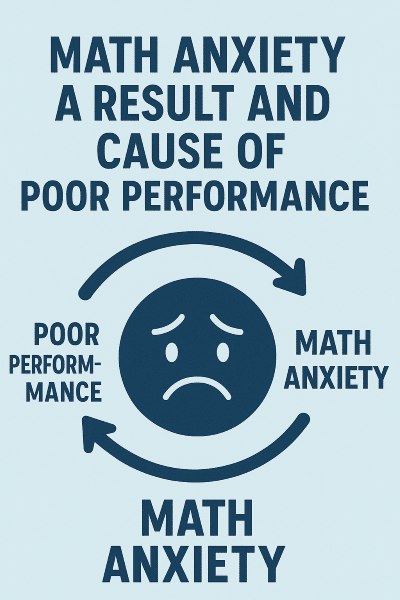
The authors propose that math anxiety is not just a result of poor performance but also a cause, creating a vicious cycle of failure and fear. They argue that math anxiety in DD is distinct from general anxiety and should be assessed and addressed specifically.
Finally, the researchers suggest that affective priming could serve as an indirect measure of math anxiety, helping to identify children who associate math with fear, even if they don’t express it explicitly. This has important implications for early intervention, suggesting that reducing math anxiety may be as critical as improving numerical skills in supporting children with DD.