
Television is a fundamental part of many children’s lives. Many kids spend hours each day watching television, and when time spent on streaming services, computers, tablets, smartphones, and video games is added, screen time can quickly add up. Is this simply a harmless way for children to pass the time, or could it affect their development?
Research suggests that excessive screen exposure, especially during the early years of life, may have consequences for attention, learning, and behavior.
The developing brain
The first few years of life are a period of extraordinary brain development. During this time, the brain is highly plastic, meaning it is constantly growing and changing in response to a child’s experiences.
Young children learn best through direct interaction with people and the world around them. Talking, playing, exploring, building, drawing, and engaging in imaginative activities all help strengthen the neural networks that support language, attention, self-control, and problem-solving.
Television, by contrast, is largely a passive experience. While educational programs may teach specific facts or vocabulary, they cannot replace the rich, interactive experiences that are essential for healthy cognitive development.
Television and attention problems
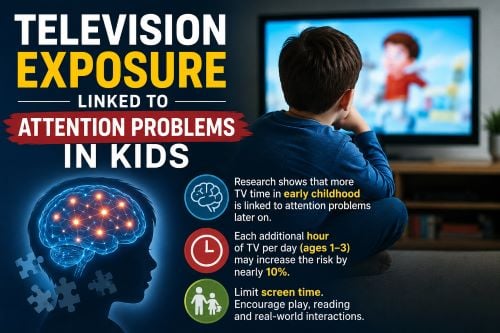
A widely cited study published in Pediatrics examined the relationship between early childhood television viewing and later attention problems. Researchers from Seattle Children’s Hospital found that television exposure between the ages of one and three was associated with attention difficulties at age 7.
The study reported that each additional hour of television watched per day between the ages of one and three increased the risk of attention problems by nearly 10 percent. These attention problems included symptoms commonly associated with ADHD. Importantly, the researchers controlled for factors such as cognitive stimulation in the home and emotional support from parents.
The findings suggest that limiting television exposure during the formative years may help reduce a child’s risk of developing attention-related difficulties later in life.
Why might television affect attention?
Researchers have proposed several possible explanations.
One theory is that many television programs are designed to capture and hold attention through rapid scene changes, bright colors, and constant stimulation. Young brains may become accustomed to this high level of sensory input and subsequently find slower-paced real-world activities less engaging.
Another possibility is that television displaces activities that are critical for developing attention skills. Time spent watching screens is time not spent reading, engaging in conversation, solving problems, playing outdoors, or participating in imaginative play.
Some researchers have also suggested that excessive screen exposure may affect sleep quality, which in turn can contribute to difficulties with attention, memory, and self-regulation.
What does recent research show?
Research conducted since the original study has continued to find links between heavy screen use and attention difficulties.
Several large studies have reported associations between increased screen time and higher rates of attention problems, impulsivity, and difficulties with executive functioning. Executive functions include skills such as focusing attention, resisting distractions, planning, organizing, and controlling impulses.
Researchers caution that screen time alone does not necessarily cause ADHD. Children who are already prone to attention difficulties may be drawn to screens, and many other factors influence attention development. Nevertheless, the growing body of evidence suggests that excessive screen exposure during childhood may contribute to attention-related challenges.
Other risks of excessive screen time
Attention problems are not the only concern.
Research has linked excessive screen use to:
- Reduced physical activity and increased risk of obesity
- Sleep disturbances
- Delays in language development among very young children
- Behavioral problems
- Reduced academic performance
- Increased exposure to inappropriate content
The effects vary depending on a child’s age, the amount of screen time, and the type of content viewed.
What parents can do
Parents do not need to eliminate screens completely. Instead, experts generally recommend moderation and thoughtful supervision.
Some practical guidelines include:
- Avoid routine screen exposure for children under age 2, except for video chatting.
- Set reasonable daily limits on recreational screen time.
- Keep televisions, tablets, and smartphones out of children’s bedrooms.
- Encourage reading, outdoor play, creative activities, and family conversations.
- Watch programs together and discuss the content.
- Prioritize sleep, physical activity, and face-to-face interaction.
Attention matters for learning
Attention is one of the most important cognitive skills for learning. Children use attention when listening to a teacher, following instructions, reading, solving math problems, and completing homework.
While television and digital media are now part of everyday life, parents should ensure that screen time does not crowd out the activities that help children develop strong attention skills. Rich interactions with people, books, games, and the physical world provide the experiences that build attention, self-control, and other cognitive skills essential for success in school and life.