
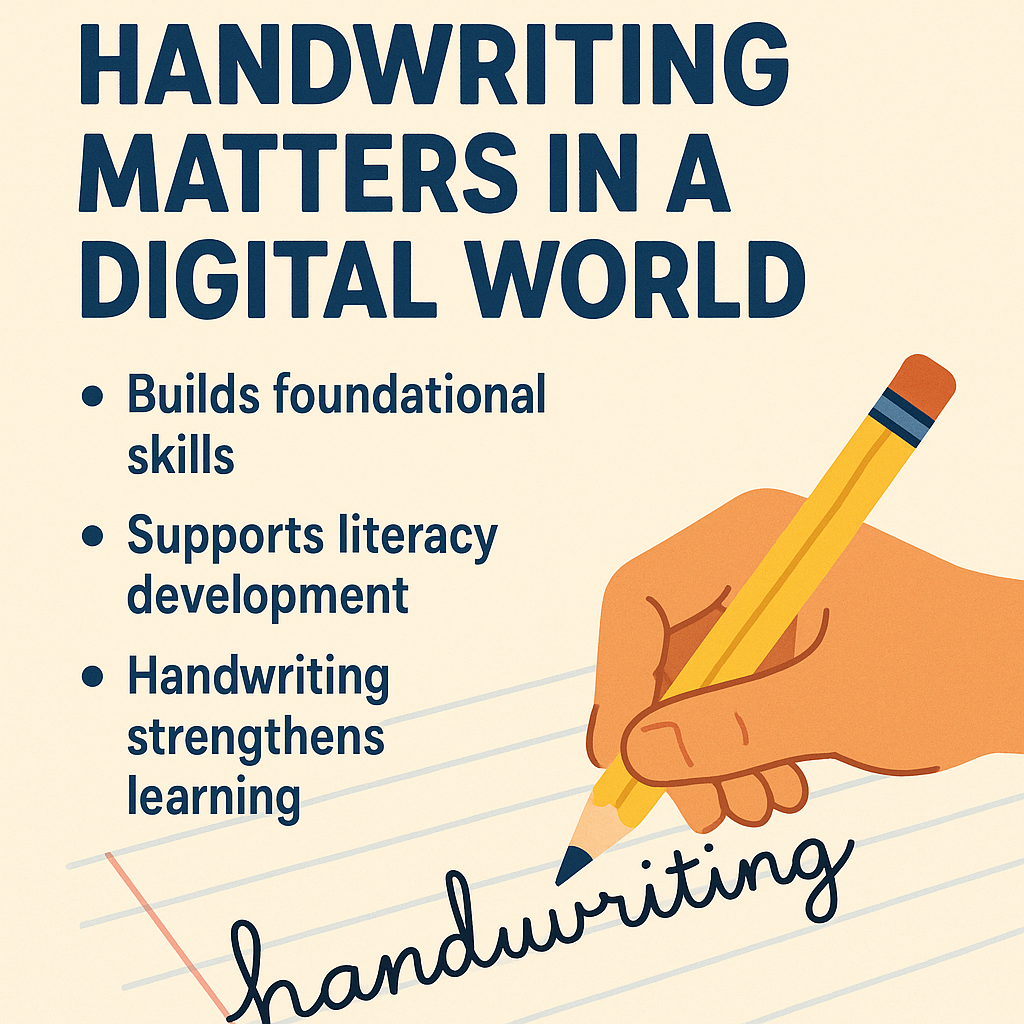
Handwriting matters more than most people realize—for both practical and cognitive reasons. Even in a tech-driven world, putting pen to paper offers benefits that screens simply can’t replace. Here’s why handwriting still holds value:
Builds foundational skills
- Fine motor control: Handwriting strengthens hand muscles and fine motor coordination—skills essential not just for writing but for everyday tasks like tying shoes or using scissors.
- Organizational skills: Writing by hand encourages children to think about how to structure a page, form sentences, and organize ideas—all of which support executive function.
.
Supports literacy development
- Letter recognition: Forming letters by hand helps students recognize them more quickly when reading.
- Reading fluency: Research shows that children who regularly practice handwriting tend to read more fluently — likely because they become more familiar with the shape and structure of letters and words.
- Spelling and word recall: Writing out words strengthens the brain’s ability to remember spelling patterns and improves word retrieval during writing and reading.
Handwriting strengthens learning
- Better comprehension: Handwriting promotes active learning. When students take notes by hand, they’re more likely to paraphrase and process ideas rather than copy word-for-word, leading to deeper understanding.
- Memory retention: Writing by hand improves encoding. The physical act of writing helps embed information more firmly in long-term memory.
What happens when handwriting is neglected?
- Students who struggle with handwriting may lose confidence in expressing themselves.
- When writing feels difficult, children often avoid it — which can hinder creativity, written expression, and academic success.
- Over-reliance on typing in early years may limit the development of motor memory and visual letter recognition.
A balanced approach is best
Many schools now adopt a hybrid model: teach and reinforce handwriting during the foundational years while also integrating typing and digital literacy skills. Typing is essential, but it’s not a complete replacement for the cognitive and developmental benefits of handwriting.