
Rote learning—memorizing through repetition—has long been cast as the villain in modern education. It’s often blamed for stifling creativity, discouraging deep understanding, and turning students into passive fact absorbers. With the rise of inquiry-based learning and the emphasis on 21st-century skills like critical thinking and problem-solving, rote learning seems like a relic of the past.
But here’s the twist: research shows that rote learning still has a valuable role to play in education, particularly when it comes to building the strong cognitive foundations necessary for more advanced thinking. In fact, dismissing rote learning entirely may be as shortsighted as relying on it exclusively.
The cognitive science behind rote learning
Cognitive psychologists have long studied the limits of working memory—the part of the brain that holds and processes new information. Working memory has a notoriously small capacity, which makes learning complex new ideas especially difficult unless key facts are already stored in long-term memory.
That’s where rote learning shines.
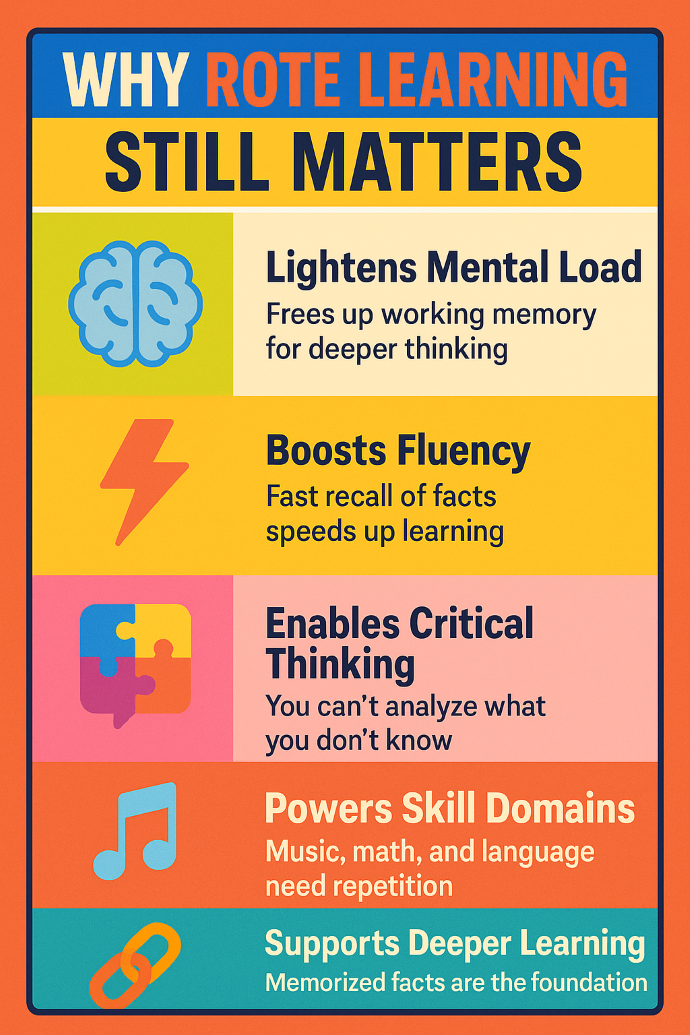
When learners have quick, automatic access to basic facts, they free up mental space to tackle higher-order problems. For example, a child who has memorized multiplication tables will solve math problems more efficiently, allowing them to focus on strategy rather than basic computation. Similarly, a fluent reader who has memorized high-frequency words won’t be bogged down decoding every letter; they can instead focus on comprehension and inference.
Foundational knowledge enables flexibility
Some critics argue that rote learning discourages flexible thinking, but this misses a key point. Flexibility in thought depends on a foundation of solid knowledge. You can’t think critically about something you don’t know.
In his book Why Don’t Students Like School?, cognitive scientist Daniel Willingham points out that critical thinking is not a generic skill—it’s domain-specific. For instance, a student needs a solid mental library of names, dates, and events to evaluate a historical argument. These don’t need to be reinvented every time; they must be memorized first and then applied.
This doesn’t mean memorization alone is sufficient; rather, it means memorization supports deeper learning.
Automaticity: A hidden superpower
One of the most underrated benefits of rote learning is automaticity—the ability to recall information instantly, without conscious effort. Automaticity is especially important in fields like language learning, mathematics, and music, where fluency depends on mastering basic patterns and structures.
Take language learning: knowing irregular verb conjugations by heart allows a speaker to form complex sentences without hesitation. In music, muscle memory acquired through rote repetition enables performers to focus on interpretation rather than execution.
The myth of either/or
Too often, the debate around rote learning becomes polarized: either you’re a progressive championing critical thinking or a traditionalist stuck in the past. But this false dichotomy ignores a more balanced truth. Modern education should not be about choosing between rote learning or critical thinking. It should be about knowing when and how to use each.
In the early stages of learning, repetition and memorization help students build a base of essential knowledge. As they progress, they can use that foundation to analyze, evaluate, and create. Rote learning becomes a stepping stone, not a ceiling.
Practical implications for teaching
Educators who understand the role of rote learning can implement it more strategically. Spaced repetition, flashcards, and retrieval practice are all tools that support memory without becoming dull or oppressive. Embedding memorization tasks within meaningful contexts—like stories, games, or hands-on activities—can also enhance engagement and retention.
Importantly, rote learning should be purpose-driven, not mindless. The goal isn’t to fill heads with trivia but to create a mental framework that enables comprehension and expertise.
Conclusion: Rote learning reclaimed
In an age obsessed with innovation, it’s tempting to dismiss anything that feels old-fashioned. But rote learning isn’t obsolete—it’s a cognitive necessity, especially for mastering foundational skills that more complex learning builds on.
The real challenge isn’t whether to use rote learning but how to integrate it wisely within a broader educational approach. When used intentionally, memorization is not the enemy of understanding; it’s the ally.
Edublox provides support for students with dyslexia, dyscalculia, and other learning difficulties. We help students worldwide overcome academic challenges and reach their full potential. Book a free consultation to discuss your child’s learning needs and discover how we can help.
References:
- Dunlosky, J., Rawson, K. A., Marsh, E. J., Nathan, M. J., & Willingham, D. T. (2013). Improving students’ learning with effective learning techniques: Promising directions from cognitive and educational psychology. Psychological Science in the Public Interest, 14(1), 4–58.
- Ericsson, K. A., Krampe, R. T., & Tesch-Römer, C. (1993). The role of deliberate practice in the acquisition of expert performance. Psychological Review, 100(3), 363–406.
- Roediger, H. L., & Butler, A. C. (2011). The critical role of retrieval practice in long-term retention. Trends in Cognitive Sciences, 15(1), 20–27.
- Willingham, D. T. (2002). Ask the cognitive scientist: Inflexible knowledge: The first step to expertise. American Educator, 26(4), 31–33.
- Willingham, D. T. (2009). Why Don’t Students Like School? A Cognitive Scientist Answers Questions About How the Mind Works and What It Means for the Classroom. Jossey-Bass.
Why Rote Learning Still Matters in the Age of Critical Thinking was authored by Sue du Plessis (B.A. Hons Psychology; B.D.), an educational specialist with 30+ years of experience in the learning disabilities field.
Edublox is proud to be a member of the Institute for the Advancement of Cognitive Education (IACE), an organization dedicated to improving learning through cognitive education and mediated learning approaches.