
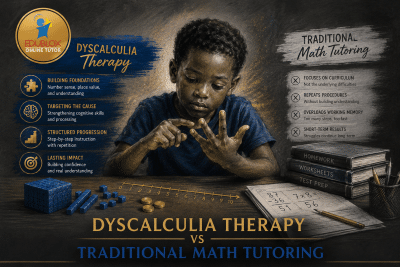
When a child struggles with math, the first response is usually straightforward: get extra math tutoring. Parents often hope that more practice, more explanations, and more homework support will eventually solve the problem. Sometimes it does. But for children with dyscalculia, traditional math tutoring alone is often not enough.
Many parents describe the same frustrating pattern. Their child attends tutoring faithfully every week. They may even improve slightly for a test, only to forget the work again a few days later. They continue counting on fingers long after their peers have moved on. Place value remains confusing. Word problems feel overwhelming. Procedures are forgotten halfway through. Despite hours of extra effort, progress is painfully slow.
This does not necessarily mean the child is lazy, unintelligent, or not trying hard enough. In many cases, it means the intervention is targeting the curriculum without addressing the underlying learning difficulties that make mathematics so challenging in the first place.
That is where the difference between traditional math tutoring and dyscalculia therapy becomes important.
Traditional math tutoring often assumes the foundations exist
Most math tutoring focuses on helping learners cope with schoolwork. Tutors reteach classroom material, explain homework, prepare learners for tests, and provide additional practice. This approach can work well for students who simply missed a concept, need more repetition, or lack confidence.
However, dyscalculic learners often struggle with far more fundamental skills.
A child with dyscalculia may have difficulty understanding quantity, recognizing numerical patterns, remembering math facts, following multi-step procedures, or understanding place value. Some learners cannot easily visualize numbers mentally. Others struggle to count backward, skip count, or estimate quantities. Many experience severe working-memory overload during calculations.
Traditional tutoring frequently assumes these foundations are already in place.
For example, a tutor may repeatedly explain long division, but the learner still struggles because they cannot reliably remember multiplication facts, track procedural steps, or understand place value. The problem is not merely the division algorithm itself. The underlying cognitive and numerical foundations are weak.
As a result, the learner may repeatedly practice incorrect methods, become anxious, and eventually begin to believe they are simply “bad at math.”
Dyscalculia is more than difficulty with school mathematics
Dyscalculia affects far more than test scores.
Many learners struggle with mental math, time, estimation, sequencing, directions, measurement, money calculations, or understanding numerical relationships. Even simple arithmetic can require enormous mental effort.
This is why dyscalculia intervention often needs to look different from ordinary tutoring.
Effective intervention must address not only the content of math but also the foundational processes that support mathematical learning. These may include:
• Number sense
• Counting skills
• Sequencing
• Working memory
• Visual-spatial processing
• Procedural memory
• Attention
• Processing speed
• Place value understanding
If these areas remain weak, learners often continue to struggle no matter how many worksheets they complete.
What dyscalculia therapy should include
Effective dyscalculia therapy is usually far more structured and systematic than ordinary tutoring.
Instead of rushing through curriculum topics, intervention should carefully rebuild mathematical foundations step by step. Learners often benefit from explicit teaching, repeated guided practice, and highly structured progression.
For example, many dyscalculic learners need intensive work on counting patterns long before they can comfortably manage more advanced calculations. Counting forward and backward, skip counting, multiplication patterns, and mental number manipulation are not “baby work” for these learners. They are essential foundations.
Place value is another critical area. Many learners with dyscalculia confuse the value of digits within larger numbers. A learner may read 81 as 18, or write 700018 instead of 7018. Without a strong understanding of place value, procedural mathematics becomes extremely difficult.
Mental math also matters enormously. Children who cannot mentally manipulate numbers often become overloaded during written calculations because each small step requires conscious effort.
This is why effective dyscalculia intervention often combines:
• explicit math instruction,
• structured sequencing,
• repeated practice,
• and cognitive skills development.
The goal is not simply to “get through the homework.” The goal is to strengthen the learner’s ability to process and understand mathematics more efficiently over time.
Why cognitive training matters
One of the major differences between dyscalculia therapy and traditional tutoring is the emphasis on cognitive skills.
Mathematics depends heavily on cognitive processes such as working memory, attention, visual processing, sequencing, and processing speed. When these systems are weak, math becomes extremely demanding.
For example, a learner may understand a procedure when the tutor explains it, but forget the steps moments later because working memory becomes overloaded. Another learner may know multiplication facts individually, yet struggle to retrieve them quickly enough during more complex calculations.
Cognitive training aims to strengthen foundational learning processes.
This does not mean that cognitive exercises replace mathematics instruction. Learners still need direct, explicit teaching in math itself. However, strengthening the cognitive foundations that support learning may help reduce overload and improve the learner’s ability to cope with mathematical tasks.
For many children, the most effective approach combines cognitive training with carefully structured math intervention.
Tutoring vs therapy is not really the right question
In reality, the best support often includes elements of both tutoring and therapy.
Children with dyscalculia still need help with school mathematics. They still need explanations, guided practice, homework support, and curriculum instruction. But they may also require something deeper and more specialized than ordinary tutoring alone.
They may need intervention that:
• slows the pace,
• rebuilds missing foundations,
• strengthens cognitive skills,
• reduces overload,
• and teaches mathematics in a highly structured and systematic way.
This is why some learners continue to struggle despite years of conventional tutoring, while others begin to improve once the intervention targets the underlying causes of their difficulties rather than only the school curriculum.
There is hope
Dyscalculia can be deeply frustrating for both learners and parents. Many children begin to believe they will “never understand math.” Repeated failure can, over time, damage confidence, motivation, and emotional well-being.
However, improvement is possible.
With appropriate intervention, many learners can significantly improve their mathematical understanding, confidence, and academic performance. Progress may be slower and require more repetition than with typical learners, but children with dyscalculia are capable of learning mathematics.
The key is understanding that they often need more than just extra practice. They need intervention that recognizes how dyscalculia affects learning and responds with structured, supportive, and carefully sequenced teaching.
Edublox offers an integrated approach that combines cognitive training with academic tutoring for students with dyscalculia and other learning challenges. We support families worldwide. Book a free consultation to discuss your child’s learning needs.
Dyscalculia Therapy vs Traditional Math Tutoring was authored by Sue du Plessis (B.A. Hons Psychology; B.D.), a dyscalculia specialist with 30+ years of experience in learning disabilities.