
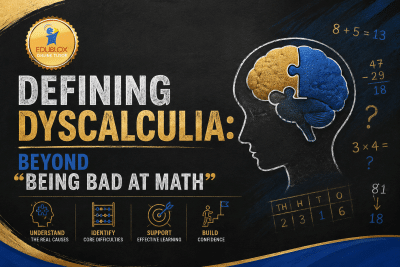
Many people assume dyscalculia simply means being “bad at math.” A child struggles with multiplication tables, counts on fingers longer than expected, or repeatedly fails math tests, and the label is applied almost casually. However, dyscalculia is far more complex than ordinary difficulty with school mathematics.
Some learners dislike math because they missed foundational concepts, experienced poor teaching, or developed anxiety after repeated failure. Dyscalculia is different. It is generally considered a specific learning difficulty that affects the ability to understand and work with numbers and mathematical concepts.
Yet, despite growing awareness, dyscalculia remains surprisingly difficult to define.
Researchers, psychologists, educators, and medical organizations often describe it in slightly different ways. Some definitions focus on number sense, others on arithmetic performance, and others on the cognitive processes that support mathematical learning. This can make dyscalculia confusing for parents and teachers who simply want to understand why a child is struggling.
Why dyscalculia is difficult to define
Unlike a broken bone or a medical illness, which can be diagnosed with a single test, dyscalculia does not present in exactly the same way in every learner.
One child may struggle mainly with number sense and quantity. Another may understand basic quantities but become overwhelmed by procedures and multi-step calculations. Some learners cannot remember math facts. Others struggle with place value, sequencing, estimation, or mental calculations.
This variability makes dyscalculia difficult to reduce to one simple symptom.
In addition, researchers do not always agree on the underlying cause. Some theories emphasize deficits in number sense, while others highlight difficulties with working memory, visual-spatial processing, attention, or procedural learning. Increasingly, many experts recognize that dyscalculia likely involves multiple interacting weaknesses rather than a single isolated problem.
Formal definitions of dyscalculia
The DSM-5, the diagnostic manual used by psychologists and psychiatrists, classifies dyscalculia under Specific Learning Disorder with impairment in mathematics. Difficulties may involve:
- number sense,
- memorization of arithmetic facts,
- accurate or fluent calculation,
- and mathematical reasoning.
Similarly, the International Classification of Diseases (ICD-11) describes dyscalculia as significant and persistent difficulties learning mathematical skills that are not explained by intellectual disability, inadequate schooling, or other conditions alone.
Educational organizations often use more practical definitions. The British Dyslexia Association describes dyscalculia as a difficulty understanding number-related concepts and using symbols and functions needed for mathematics.
Although the wording varies, most modern definitions agree on one important point: dyscalculia involves persistent and significant difficulty in learning mathematics despite appropriate instruction and normal educational opportunities.
What most definitions have in common
While definitions vary, several core characteristics appear repeatedly across the research literature.
Difficulty understanding numbers
Many learners with dyscalculia struggle to develop a strong sense of quantity and numerical relationships. Numbers may feel abstract and meaningless rather than intuitive.
For example, some learners struggle to instantly recognize that 8 is larger than 6, estimate quantities quickly, or understand numerical magnitude.
Difficulty remembering math facts
Many dyscalculic learners struggle to memorize and retrieve basic arithmetic facts such as:
- 6 + 7 = 13
- 8 × 4 = 32
Even after repeated practice, facts may not become automatic.
Procedural difficulties
Mathematics often requires learners to follow sequences of steps in the correct order. Learners with dyscalculia frequently lose track of procedures, skip steps, or confuse operations.
Long division, borrowing, carrying, fractions, and algebraic procedures may become particularly overwhelming.
Place value difficulties
Place value confusion is extremely common. A learner may reverse numbers, misunderstand the value of digits, or struggle to interpret larger numbers correctly.
For example, a learner might read 81 as 18 or write 7000183 instead of 7183.
Working-memory overload
Many learners with dyscalculia become overloaded during calculations because too many mental processes must happen simultaneously. They may forget steps midway through a problem or lose track of calculations while solving it.
Dyscalculia is not a sign of low intelligence
One of the most important misconceptions about dyscalculia is the belief that learners who struggle with math are simply not intelligent.
This is not true.
Many learners with dyscalculia have average or above-average intelligence. Some perform very well in reading, verbal reasoning, creativity, science, art, or other academic areas while continuing to struggle severely with mathematics.
In fact, the uneven profile is often a defining characteristic of specific learning difficulties.
A child may speak intelligently, understand complex ideas, and perform well in many subjects, yet still struggle to remember basic math facts or understand numerical procedures.
Dyscalculia vs ordinary math difficulties
Not every child who struggles with math has dyscalculia.
Some learners experience temporary difficulties due to:
- gaps in instruction,
- poor attendance,
- anxiety,
- weak study habits,
- or limited practice.
Dyscalculia is usually more persistent and less responsive to standard interventions.
Learners often continue struggling despite:
- extra tutoring,
- repeated explanations,
- additional homework,
- and classroom support.
The difficulties are often evident across multiple areas of mathematics and may persist for many years unless specialized intervention is provided.
Why definitions matter
Definitions are not merely academic.
How dyscalculia is defined affects:
- diagnosis,
- intervention,
- expectations,
- and emotional understanding.
If dyscalculia is misunderstood as laziness or lack of effort, learners may experience repeated failure without receiving appropriate support. Parents may become frustrated. Teachers may assume the learner simply needs more practice.
However, if dyscalculia is understood as a genuine learning difficulty involving underlying cognitive and numerical weaknesses, intervention can become far more targeted and effective.
Understanding the definition also helps explain why traditional math tutoring alone is sometimes insufficient. Many dyscalculic learners require carefully structured intervention that rebuilds mathematical foundations step by step while also supporting the cognitive skills involved in mathematical learning.
A practical definition of dyscalculia
In practical terms, dyscalculia can be understood as:
A severe and persistent difficulty learning and understanding mathematics, often involving weaknesses in number sense, place value, mathematical procedures, and memory despite normal intelligence and appropriate instruction.
This definition recognizes that dyscalculia is not simply about failing math tests. It affects how learners process, understand, remember, and manipulate numerical information.
For many learners, mathematics becomes mentally exhausting because even basic calculations require significant conscious effort.
The good news is that learners with dyscalculia can improve significantly with appropriate intervention. However, effective support usually requires more than extra worksheets or repeated explanations. Learners often benefit from highly structured, carefully sequenced instruction that strengthens both mathematical foundations and the cognitive processes that support learning.
Understanding dyscalculia properly is the first step toward providing that support.
Edublox offers an integrated approach that combines cognitive training with academic tutoring for students with dyscalculia and other learning challenges. We support families worldwide. Book a free consultation to discuss your child’s learning needs.
Defining Dyscalculia: Beyond “Being Bad at Math” was authored by Sue du Plessis (B.A. Hons Psychology; B.D.), a dyscalculia specialist with 30+ years of experience in learning disabilities.