
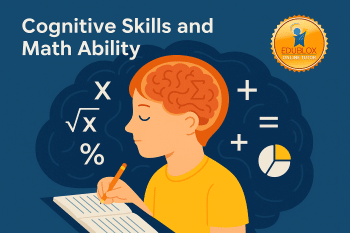
Math literacy is essential in modern life. Everyday tasks—such as paying bills, budgeting, and comparing prices—all involve numbers. Every job, from rocket scientist to sheepherder, requires some form of math. And many life decisions are based on numerical information; to choose well, we need to be numerate.
Many factors can contribute to a child’s difficulty mastering mathematics. Anxiety is one. Another is weak cognitive skills.
Cognitive skills are the mental abilities we use to acquire knowledge, manipulate information, reason, and solve problems. When these skills are strong, learning is faster and easier; when they are weak, learning becomes a struggle.
The following cognitive skills play a crucial role in mathematics. If any of these are particularly weak, they may contribute to—or even cause—dyscalculia.
Directionality
Directionality refers to the ability to understand and use concepts related to direction — such as left, right, up, down, front, and back — and to apply them consistently to oneself and to objects or symbols in space.
Directional confusion can manifest in various ways, ranging from uncertainty about left and right to difficulty interpreting a map. It also affects concepts such as up and down, top and bottom, compass directions, keeping one’s place in a game, or mirroring a teacher’s movements during gym class.
Impact on math:
Students with directional confusion may invert numbers (for example, writing Ɛ for 3). They may also be confused by the inconsistent “starting points” of different algorithms. Addition usually starts on the right and works left with the answer at the bottom, while long division begins on the left and works right with the answer at the top — a recipe for frustration if directions aren’t firmly anchored.
Sequencing
A sequence is a list of items in a specific order. Numbers 1–10 are most children’s first mathematical sequence. There are many types of sequences in math:
- Arithmetic sequence: each term is created by adding or subtracting a fixed number (e.g., 3, 6, 9, 12, 15).
- Geometric sequence: each term is created by multiplying or dividing by a fixed number (e.g., 2, 4, 8, 16, 32).
- Harmonic sequence: the reciprocals form an arithmetic sequence, and none can be zero (e.g., 1/2, 1/4, 1/6, 1/8, 1/10).
- Fibonacci sequence: each term is created by adding the two previous numbers, starting 0, 1 (e.g., 0, 1, 1, 2, 3, 5, 8, 13, 21…).
Impact on math:
Being able to recognize and remember sequences is a vital skill. Some children manage safe, familiar sequences such as 10, 20, 30, 40, but stumble when faced with variations like 12, 22, 32, 42.
Visual perception
Visual perception is the brain’s ability to interpret what the eyes see. When perception is weak, a student may see correctly but still interpret inaccurately. This can result in confusing symbols (+, ÷, ×), misreading numbers (such as 6 and 9, or 3 and 5), overlooking a decimal point, or mixing up notations like 2x, x², and x × 2.
Impact on math:
Weak visual perception makes it difficult to navigate worksheets or textbooks, especially when problems are crowded together. A student may lose their place or copy a number incorrectly. The demand to work quickly often intensifies these challenges; for example, a student might not notice that the operation sign has changed from + to × and continue adding, producing wrong answers.
Spatial awareness
Spatial awareness is the ability to understand one’s position in relation to objects and the position of objects in relation to each other. It encompasses concepts such as direction, distance, and location, and underpins numerous daily tasks.
Impact on math:
Weak spatial awareness can impact place value (accurately lining up numbers), geometry (understanding shapes and dimensions), and algebra (distinguishing between 2x, x², and x × 2). These challenges often overlap with visual discrimination difficulties, compounding the problem.
Short-term and working memory
Short-term memory refers to the ability to retain information for a brief period of time. Working memory takes it a step further: it not only allows us to hold information but also to manipulate it. For example, repeating digits in the same order taps short-term memory, while repeating them backward taps working memory.
Impact on math:
Weak working memory makes even simple calculations difficult. To add 47 + 78 mentally, a student must hold the problem, compute 7 + 8 = 15, remember the 5, carry the 1, add 4 + 7 + 1 = 12, and finally assemble everything into the correct answer (125). Students with poor working memory may resort to extra notations, such as tally marks, which can slow down work and lead to further errors.
Long-term memory
Long-term memory stores information transferred from short-term memory and can last from hours to a lifetime. Unlike short-term memory, which is limited in capacity and duration, long-term memory has enormous storage potential.
Impact on math:
A key component of long-term memory is procedural memory, which enables us to remember how to perform tasks—such as riding a bike or carrying out mathematical operations. Students with dyscalculia often struggle with procedural memory. This makes it difficult for them to remember the steps of algorithms such as long division or multi-digit multiplication, even after repeated practice.
Visuospatial memory
Visuospatial memory is the ability to process and retain the identity and spatial location of an object. This skill is essential for many daily tasks and plays a critical role in mathematics.
Impact on math:
Research indicates that deficits in visuospatial memory are closely associated with dyscalculia. Szűcs and colleagues (2013) found that children with dyscalculia performed poorly on visuospatial memory tasks. More recently, Mingozzi et al. (2023) recognized visuospatial memory deficits as the main characteristic of students with mathematical difficulties.
Working speed
The speed at which a student can complete math tasks is influenced by several factors, including memory load, visual and spatial skills, and even writing speed. Students with learning difficulties often require additional time to complete math assignments.
Impact on math:
Chinn (1995) compared the average time taken to complete 21 basic numeracy questions between mainstream schoolchildren and students at a specialist dyslexia school. On average, the students with dyslexia took 50% longer to attempt the task. This is significant because, according to the British Dyslexia Association, between 50% and 60% of students with dyslexia also struggle with math. Similarly, Landerl and Moll (2010) found that 23–49% of primary school children experience both dyslexia and dyscalculia.
Vocabulary
Mathematics has its own language, which can be confusing for students with weak language skills. Many math words also have everyday meanings that differ from their mathematical use. For example, the word “operation” can refer to addition, subtraction, multiplication, or division in mathematics, but in daily life, it might also refer to a surgical procedure.
Impact on math:
This dual meaning can make math vocabulary seem divorced from real life, adding an extra layer of difficulty. Additionally, mathematics employs a vast array of symbols that must be understood and memorized. Students who struggle with language may therefore face a double challenge: grasping both the specialized vocabulary and the symbolic notation of mathematics.
How to help
The good news is that cognitive weaknesses are not set in stone. With targeted training and practice, skills like memory, sequencing, spatial awareness, and vocabulary can be strengthened. As these skills improve, so does a student’s ability to learn and succeed in mathematics.
Impact on learning:
Strengthening cognitive skills doesn’t just make math easier — it helps students become more confident, independent learners across all subjects.
At Edublox, we specialize in cognitive training and educational interventions that help learners become smarter, read faster, and master math with greater ease. Our programs enable them to overcome reading difficulties and other learning obstacles, empowering them to become lifelong learners and achieve their highest educational goals.
👉 Watch this playlist of customer reviews to see how Edublox training and tutoring help turn dyslexia and dyscalculia around.
👉 Book a free consultation to discuss your child’s math learning needs.
.
References for Cognitive Skills and Math Ability:
- Chinn, S. J. (1995). A pilot study to compare aspects of arithmetic skill. Dyslexia Review, 4, 4-7.
- Landerl, K., & Moll, K. (2010). Comorbidity of learning disorders: Prevalence and familial transmission. Journal of Child Psychology and Psychiatry, 51(3), 287–294.
- Mingozzi, A., Tobia, V., & Marzocchi, G. M. (2024). Dyslexia and dyscalculia: Which neuropsychological processes distinguish the two developmental disorders? Child Neuropsychology, 30(1), 1–21.
- Szűcs, D., Devine, A., Soltesz, F., Nobes, A., & Gabriel, F. (2013). Developmental dyscalculia is related to visuo-spatial memory and inhibition impairment. Cortex, 49(10), 2674–2688.
- Cognitive Skills and Math Ability was authored by Sue du Plessis (B.A. Hons Psychology; B.D.), an educational specialist with 30+ years of experience in the learning disabilities field.
- Edublox is proud to be a member of the Institute for the Advancement of Cognitive Education (IACE), an organization dedicated to improving learning through cognitive education and mediated learning approaches.