
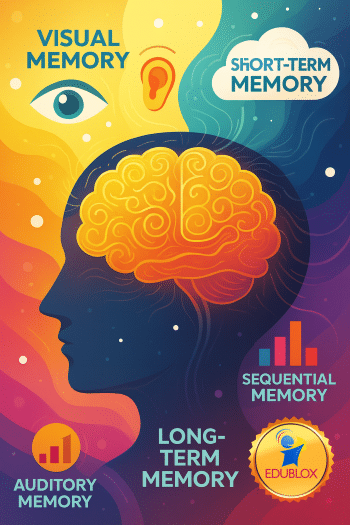
Why can a child sing every word of a song after hearing it once, yet forget what their teacher said only moments ago? The answer is memory — not one single ability, but a collection of systems that work together to help us learn, recall, and apply information.
Scientists now recognize at least 17 different types of memory, each serving a unique role. Some last just a split second, like the visual trace left after seeing a flash of light. Others last a lifetime, like the memory of your first day at school.
In this article, we’ll explore these 17 types, explain which ones are most crucial for learning, and show how they can be strengthened through targeted training.
.
Table of contents:
- Memory takes many different forms
- Sensory memory
- Short-term memory
- Working memory
- Our senses are involved
- Sequential or visuospatial
- How to improve memory
- Program to improve memory
- Conclusion
Memory takes many different forms
For much of history, people imagined memory as a single “filing cabinet” in the brain — one place where experiences were stored and later retrieved. Modern neuroscience tells a different story. Memory is not a single process, and it is certainly not housed in a single location. Instead, it is spread across the brain, with different systems handling various types of information and time scales.
Think of the brain less as a cabinet and more as a giant supercomputer. Billions of neurons are constantly firing, passing messages from one area to another, creating pathways that allow us to recognize a face, recall a phone number, or learn a new skill. These pathways differ depending on whether we are holding on to a thought for a few seconds, storing knowledge for years, or retrieving vivid images from childhood.
Scientists now know that memory takes many different forms. There is a difference between remembering a phone number long enough to dial it and remembering your own phone number, which you can recall at any time. Each of these draws on a different system in the brain.
The main categories of memory are sensory, short-term (or working), and long-term, based on how long the information is stored. Within these broad categories lie many specialized types — from visual and auditory memory to sequential and episodic memory. Together, they form the foundation of how we learn, communicate, and navigate daily life.
Sensory memory
Sensory memory is the shortest-lasting type of memory — but also the first step in the process. It acts as a buffer for the flood of information that reaches us through our five senses. Most of this information disappears almost instantly, but without sensory memory, we would never have the raw material needed for learning and long-term storage.
Each sense has its own specialized form of sensory memory:
- Iconic memory (visual): A photographic trace of what the eyes have just seen. If you glance at a page of text and then shut your eyes, the lingering image for a fraction of a second is iconic memory. It usually fades in less than half a second.
- Echoic memory (auditory): A brief “echo” of sounds that lasts a little longer — typically two to four seconds. This allows us to follow conversations and understand sentences, even when we miss a word or two.
- Haptic memory (touch): The short-lived memory of a sensation on the skin, such as the feeling of a handshake or the texture of a fabric.
- Gustatory memory (taste): The brief memory of flavors after the food or drink is gone.
- Olfactory memory (smell): The immediate memory trace of scents — closely tied to emotional reactions, since smell is strongly linked to the brain’s limbic system.
Although fleeting, sensory memory is critical. For example, your iconic memory and ability to separate foreground from background determine your eye span — the number of letters or words you can take in at once. A wider eye span makes reading faster and more fluent.
Having filtered through the senses, information either fades away or passes into the next stage: short-term memory. Unlike sensory memory, which is fleeting and automatic, short-term memory is where we consciously hold and use information, such as keeping a phone number in mind long enough to dial it.
Short-term memory
Short-term memory is the brain’s temporary storage system. It holds information for just a few seconds — usually no more than 15 to 30 — unless we actively rehearse it. Its capacity is limited, often described as about seven pieces of information at a time (give or take two).
Everyday examples include:
- Repeating a phone number long enough to dial it.
- Remembering the name of someone you just met.
- Holding the beginning of a sentence in mind while you finish reading it.
When short-term memory is weak, children may quickly forget instructions, lose their place in reading, or struggle to recall what was just said in class. These lapses aren’t laziness — they’re the natural result of a system that can only hold so much at once.
Working memory
Closely related to short-term memory is working memory — but with an important difference. While short-term memory is about holding information briefly, working memory involves holding and actively using that information. It’s the brain’s notepad where we jot things down mentally and manipulate them in real time.
A few examples:
- Repeating a string of digits backward (not just forward).
- Solving a mental math problem such as (3 × 3) + (4 × 2), where you must keep the first step (9) in mind while completing the second (8).
- Writing a paragraph, where you need to remember the previous sentence while composing the next.
Researchers debate whether working memory is truly distinct from short-term memory or merely a more active form of it. Psychologist Nelson Cowan suggests that short-term memory is a passive storage system, able to hold about four items without rehearsal, while working memory relies on attention and rehearsal, thereby stretching that capacity closer to seven items.
In the classroom, weaknesses in working memory often look like:
- Forgetting multi-step instructions midway through.
- Reading a passage but losing track of its meaning by the end.
- Struggling with mental arithmetic or multi-step math problems.
- Taking longer to complete tasks that require juggling several pieces of information.
Because it acts as the bridge between learning and long-term storage, working memory is considered one of the strongest predictors of academic success.
When working memory does its job well, information doesn’t just vanish. Instead, it can be encoded and stored more permanently in long-term memory. This is where knowledge, experience, and skills take root — sometimes for a lifetime.
Long-term memory
Long-term memory is the system that takes information from short-term and working memory and stores it for hours, days, years, or even a lifetime. Unlike short-term memory, which is limited in both capacity and duration, long-term memory has an enormous storage capacity. Once information is consolidated here, it can be retrieved whenever needed — whether it’s recalling multiplication tables, the capital of France, or the memory of your first day at school.
Researchers distinguish between several types of long-term memory:
- Semantic memory: Knowledge of facts, rules, concepts, and general information. Example: knowing that Paris is the capital of France or that The Rolling Stones are a rock band.
- Episodic memory: Memories of specific personal experiences, tied to a time and place. Example: remembering where you were the first time you heard Exile on Main Street.
- Procedural memory: Memory of how to do things — riding a bike, typing on a keyboard, or tying shoelaces. While semantic memory is “knowing that,” procedural memory is “knowing how.”
Children with long-term memory weaknesses may study diligently for tests but struggle to recall the material during the exam. They often forget information taught earlier in the year, struggle to retrieve rules of grammar or math, and sometimes can’t answer questions in class even when teachers believe they “know” the content.
Long-term memory forms the knowledge base that supports all future learning. The richer and more accessible it is, the more efficiently students can connect new information to what they already know.
Our senses are involved too
Memory doesn’t only differ by time span (sensory, short-term, long-term). It also differs by the type of information being stored. Two of the most important forms for learning are visual memory and auditory memory.
Visual memory is the ability to store and retrieve what the eyes have seen once the object or text is no longer in front of us. It is crucial for reading, spelling, and building a sight vocabulary.
Examples include:
- Remembering the spelling of a word after glancing at it.
- Visualizing a map or diagram while solving a problem.
- Recognizing faces or recalling the layout of a page.
Researchers estimate that as much as 80 percent of classroom learning depends on visual input, making visual memory a cornerstone of academic success. Weaknesses here often appear as difficulty remembering how words “look,” frequent spelling mistakes, or problems recalling visual sequences, such as numbers and shapes.
Auditory memory, on the other hand, is the ability to receive, process, store, and recall information presented orally. It underpins both listening comprehension and even silent reading (since we “hear” the words in our head as we read).
Examples include:
- Remembering instructions given verbally.
- Recalling facts from a teacher’s lecture.
- Retelling a story that was read aloud.
When auditory memory is weak, children often pick up only fragments of what is said, lose track of conversations, and struggle to follow multi-step instructions. Poor auditory memory can also hinder phonics, since blending sounds into words requires holding and manipulating sound patterns in mind.
Both visual and auditory memory are trainable. Strengthening them has a direct impact on reading fluency, comprehension, spelling, and overall learning.
Sequential or visuospatial
Beyond visual and auditory memory, two other specialized forms play a vital role in learning: sequential memory and visuospatial memory.
Sequential memory is the ability to remember items in a specific order. It’s what allows us to recite the days of the week, dial a phone number, or read words in the correct sequence of letters.
- Visual sequential memory: recalling things seen in order (e.g., the sequence of letters in a word).
- Auditory sequential memory: recalling things heard in order (e.g., repeating a longer word like preliminary without jumbling its syllables).
Weak sequential memory often shows up in children who confuse letter order in words (name → mean → amen), mix up syllables in speech, or lose track of multi-step math processes.
Visuospatial memory, on the other hand, refers to the ability to recall shapes, patterns, colors, and locations. It enables us to navigate spaces, solve puzzles, or remember the position of objects.
A child with weak visuospatial memory may:
- Struggle to recall the location of items on a page or grid.
- Have difficulty visualizing geometric shapes.
- Show challenges in math, especially with place value or aligning numbers correctly.
Research has found that children with dyscalculia — a math learning disability — often perform poorly on visuospatial memory tasks, underscoring the critical role this skill plays in numerical understanding.
How to improve memory
Memory is not fixed. Like muscles in the body, memory systems can be trained and strengthened with the right kind of practice. In fact, scientists increasingly recognize memory as a core cognitive skill — one that underpins nearly every aspect of learning. When memory improves, progress in reading, spelling, math, and problem-solving often follows.
Improving memory is not about overtraining one single system, but rather about targeting multiple types in a balanced way. Just as a lopsided workout at the gym can build some muscles while neglecting others, focusing on only one kind of memory leaves learners vulnerable.
A well-known study by Maguire and colleagues (2006) found that London taxi drivers had enlarged posterior hippocampi — the part of the brain that stores spatial maps — but this growth came at a cost. Their anterior hippocampi were reduced in volume compared to those of bus drivers. The lesson: overdeveloping one memory system may come with trade-offs.
Cognitive scientists also emphasize the principle of mutualism — the idea that cognitive skills grow together by supporting one another. Better reasoning ability, for instance, helps a child acquire vocabulary more quickly. A stronger vocabulary, in turn, enhances reasoning. The same is true for memory: as it strengthens, it supports other skills, which then reinforce memory further (Kievit et al., 2017).
Because memory is highly responsive to training, consistent practice in multiple areas — visual, auditory, sequential, working, and more — can lead to remarkable improvements. This means learners are not “stuck” with the memory capacity they currently have. With carefully designed exercises, they can build the mental foundation needed for lasting academic success.
Program to improve memory
To translate research into results, memory training needs to be systematic, multi-cognitive, and consistent. At Edublox, our program is designed for learners aged 7 to 70 and targets eight crucial types of memory: iconic, short-term, working, long-term, visual, auditory, sequential, and visuospatial. By strengthening these, we also indirectly support other cognitive processes such as attention, reasoning, and processing speed.
Guidelines for success
- Study the program carefully
Begin by familiarizing yourself with each exercise. Don’t try to learn everything at once; let the learner master one step before moving to the next. - Start with Development Tutor
This forms the core of the program. Once the learner is comfortable here, add the other two memory exercises. - Choose a quiet time and space
Early morning often works best, but after school is fine as long as the learner has had a short break. Minimize distractions so the brain can focus. - Set a realistic schedule
Lessons take about 25–35 minutes. Aim for five sessions per week if memory difficulties are severe, or four if they are moderate. Consistency is more important than length. - Break sessions if needed
Younger learners or those with slower processing speed may benefit from two shorter sessions (e.g., Development Tutor in the morning, other exercises in the afternoon).
Edublox memory program
The Edublox program is carefully designed to target the full range of memory systems that learners need for reading, spelling, and learning success. It consists of three main components:
1. Arrows with a Twist (3–5 minutes)
This exercise has six levels of increasing difficulty. It develops a wide range of foundational skills, including:
- Divided attention
- Directionality (left/right awareness)
- Sequencing
- Rapid naming (retrieval from long-term memory)
- Working memory
2. Development Tutor (15–25 minutes, 3 exercises)
Development Tutor is the core of the program, improving multiple cognitive skills simultaneously:
- Focused and sustained attention
- Visual and auditory processing
- Processing speed
- Iconic, short-term, working, and long-term memory
- Visual and auditory memory
- Sequential and visuospatial memory
- Logical reasoning
Each lesson consists of three exercises and takes about 20 minutes to complete.
Technical requirements:
- Windows (7 or newer), or most Mac computers with Google Chrome
- Compatible with Android tablets (minimum 10″ screen, minimum FHD resolution: 1920×1080 or 1920×1200)
Parents’ role:
Parents don’t have to sit with their child during Development Tutor, but it’s essential to monitor them occasionally to ensure the exercises are completed without shortcuts (such as taking notes). The only exception is the logical thinking exercise, where aids may be used.For younger learners or those with very slow processing speed, the timer can be extended for the first 2–3 months and then reset to normal.
3. Working Memory Exercise (4–5 minutes)
This exercise has two steps:
- Step 1: strengthens long-term memory
- Step 2: targets working memory directly
Together, these steps build the learner’s capacity to hold and manipulate information in real time, supporting both academic performance and everyday functioning.
Staying the course
It’s essential to continue the program until memory deficits have been completely overcome, not just slightly improved. When practiced consistently, these exercises lay down the mental foundations for confident reading, effective spelling, and lifelong learning.
Conclusion
Memory is not one single ability but a family of systems — sensory, short-term, working, long-term, visual, auditory, sequential, visuospatial, and more — each playing a distinct role in how we learn and retain information. Weakness in even one of these areas can create hurdles in reading, spelling, math, and everyday learning.
The encouraging truth is that memory is not fixed. With the right kind of training, it can be improved at any age. A balanced, multi-cognitive approach ensures that learners don’t just build one skill in isolation, but strengthen the whole network of memory systems that support lasting academic success.
At Edublox, our memory program does exactly this. Through structured, research-based exercises, it helps learners move from frustration to confience — building the mental foundation necessary for reading, spelling, comprehension, and beyond.
At Edublox, we help children with dyslexia, dyscalculia, and other learning difficulties build the skills they need to succeed. Through cognitive training and live online tutoring, we support families in the U.S., Canada, Australia, and around the world. Schedule a free consultation to talk about your child’s needs.
References for Memory Explained: 17 Types and How to Improve Them:
- Cowan, N. (2001). The magical number 4 in short-term memory: A reconsideration of mental storage capacity. Behavioral and Brain Sciences, 24(1): 87–114.
- Kievit, R. A., Lindenberger, U., Goodyer, I. M., Jones, P. B, Fonagy, P., Bullmore, E. T., & Dolan, R. J. (2017). Mutualistic coupling between vocabulary and reasoning supports cognitive development during late adolescence and early adulthood. Psychological Science, 28(10): 1419-31.
- Maguire, E. A., Woollett, K., & Spiers, H. J. (2006). London taxi drivers and bus drivers: A structural MRI and neuropsychological analysis London taxi drivers and bus drivers. Hippocampus, 16(12): 1091-101.
- Miller, G. A. (1956). The magical number seven, plus or minus two: Some limits on our capacity for processing information. Psychological Review, 63(2): 81–97.
- Tulving, E. (1985). Elements of episodic memory. OUP Oxford.