Free Consultation

LD Articles, Resources and Success Stories

Dysgraphia Symptoms, Types, Causes, Treatment

Dysgraphia is a neurological learning disability that can affect handwriting, spelling, and the ability to express ideas on paper. It is not simply “messy writing” but a complex challenge involving motor skills, language, and cognition. Early identification and tailored intervention can make a lasting difference.

Read more...

20 Facts About Dysgraphia

These 20 facts about dysgraphia will help you understand the signs, science, and support strategies for one of the most overlooked learning challenges.

Read more...

50 Reasons Why Spelling Is Important

Spelling is often the unsung literacy hero — underappreciated until it fails. A misspelled word can derail a résumé, distort meaning, or make you look like you texted in a hurry. But the importance of spelling goes far beyond surface-level neatness. It’s deeply tied to reading, writing, brain development, and confidence. Here are 50 research-backed reasons why spelling deserves a front-row seat in education.

Read more...

Why Handwriting Matters in a Digital World

Handwriting matters more than most people realize—for both practical and cognitive reasons. Here's why it still holds value, even in a digital world.

Read more...

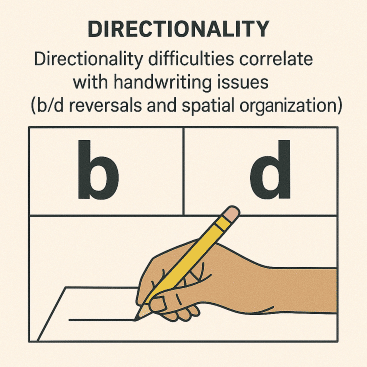
Link Between Directionality and Handwriting

Spatial directionality—the awareness of left/right, up/down, and forward/backward in space—is a crucial underpinning of fluent, legible handwriting. When children struggle with directional concepts, several handwriting features can suffer.

Read more...

How to Identify Handwriting Problems

Identifying handwriting problems can help improve writing skills, especially for students or anyone struggling with legibility, speed, or comfort. Here’s a breakdown of how to identify handwriting issues and what to look for.

Read more...

5 Dysgraphia Success Stories

Most dysgraphia success stories in the press are of famous people who have been successful despite dysgraphia. Our students aren’t renowned. They are ordinary people who overcame or are in the process of overcoming dysgraphia symptoms like severe spelling and handwriting difficulties.

Read more...

Handwriting Curriculum for Dysgraphia

This comprehensive handwriting curriculum for dysgraphia treats the causes: deficits in visual perception, visual memory, motor skills, sensory-motor integration.

Read more...

18 Gross Motor Activities to Improve Handwriting

Having good gross motor skills can enable a child to excel at sports. But this is only part of the benefit! Developing a child’s gross motor skills can do so much more than that – they can influence their ability to write well and even concentrate in the classroom.

Read more...

How to Improve Fine Motor Skills for Better Handwriting

Failure to attain handwriting competency often adversely affects academic success. Poor fine motor skills contribute to poor penmanship, but can be improved.

Read more...

Top 5 Reasons Why Handwriting Matters

As laptops and tablets become more commonly used as writing tools, many are ready to leave the skill of handwriting behind. A growing body of research, however, is leading psychologists and neuroscientists to emphasize the importance of teaching handwriting.

Read more...

Handwriting and Cognitive Skills

Handwriting difficulties affect between 10 and 30% of children. Research shows that handwriting deficits do not resolve without intervention. Research also shows that improving cognitive skills should be part of every child's handwriting treatment plan.

Read more...
Contact Us