
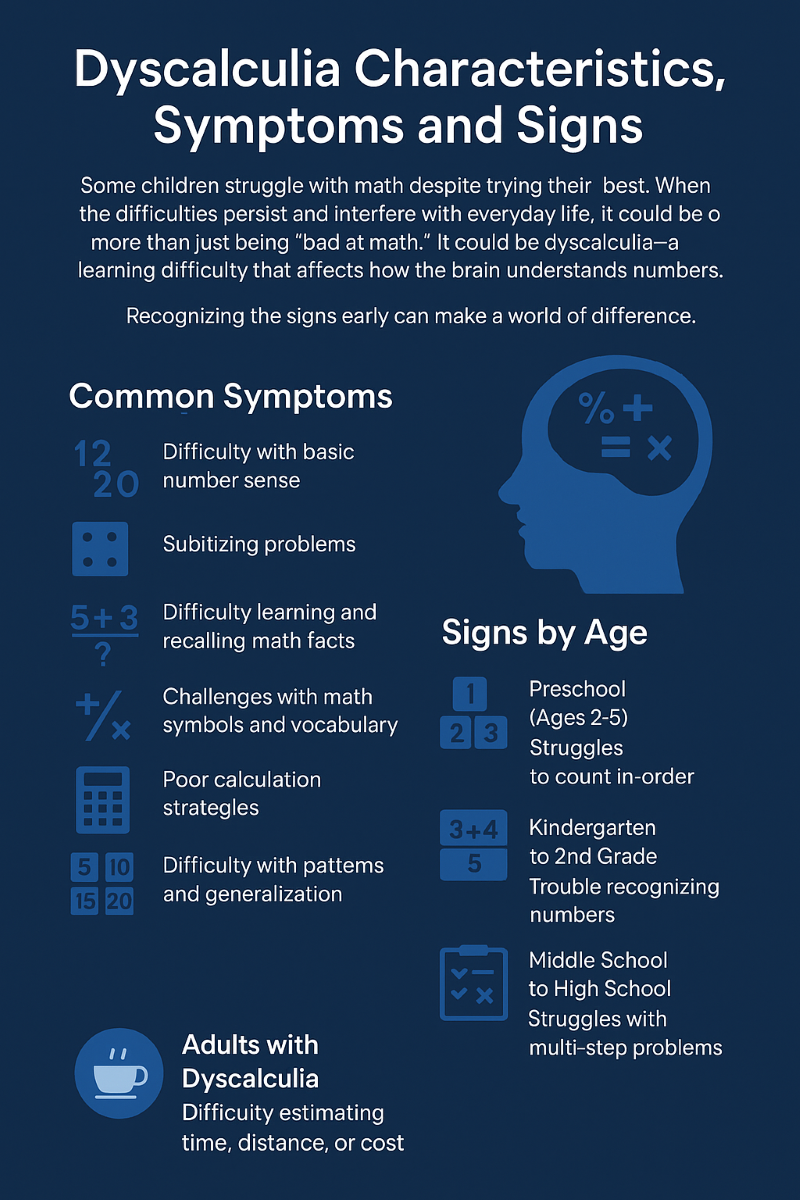
Some children struggle with math despite their best efforts. When the difficulties persist and interfere with everyday life, it could be more than just being “bad at math.” It could be dyscalculia—a learning difficulty that affects how the brain understands numbers.
In this article, we explore the characteristics, symptoms, and signs of dyscalculia—what to look for at various stages of development, how it impacts everyday life, and why early identification is crucial.
Recognizing the signs early can make a world of difference.
.
Table of contents:
- What is dyscalculia?
- Characteristics, symptoms, and signs of dyscalculia
- Dyscalculia symptoms and signs by age
- Why it matters: math skills in the real world
- Delve deeper
- Key takeaways
- Talk to a specialist
What is dyscalculia?
Dyscalculia is a specific learning difficulty that makes understanding and working with numbers unusually hard. It affects basic math tasks, such as counting, arithmetic, telling time, and understanding number concepts. These difficulties persist despite normal intelligence and adequate educational exposure.
Children with dyscalculia often struggle with simple calculations like 7 + 2 or 5 × 3—not because of laziness or lack of effort, but because their brains process numbers differently.
The DSM-5 refers to this as a “Specific Learning Disorder with impairment in mathematics.”
Characteristics, symptoms, and signs of dyscalculia
While symptoms may vary, certain patterns appear across age groups and ability levels.
1. Difficulty with basic number sense
- Struggles to understand quantities and numerical relationships
- Has trouble recognizing that 20 is larger than 12
- Cannot easily estimate amounts or compare sets
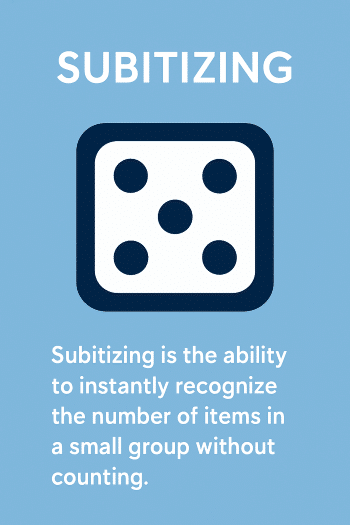
2. Subitizing problems
- Needs to count even small groups (e.g., doesn’t instantly recognize three dots)
- Difficulty with dice or domino patterns
- Poor conceptual subitizing (can’t “see” 6 as 3+3)
🔍 Subitizing is the ability to instantly recognize the number of items in a small group without counting—often weak in children with dyscalculia.
3. Difficulty learning and recalling math facts
- Slow to memorize addition and multiplication facts
- May still rely on finger counting beyond the expected age
- Frequently forgets procedures they’ve just learned
4. Challenges with math symbols and vocabulary
- Confuses +, −, ×, ÷ or doesn’t understand their meanings
- Misinterprets terms like “more than,” “less,” or “difference”
- Trouble solving word problems due to misunderstanding terms
5. Poor calculation strategies
- Uses immature or inefficient strategies (e.g., counting all rather than counting on)
- Takes a long time to complete math problems
- Struggles with mental arithmetic and multi-step calculations
6. Difficulty with patterns and generalization
- Fails to notice or extend numerical patterns (e.g., 5, 10, 15…)
- Doesn’t see connections like 3 + 4 = 7 and 30 + 40 = 70
- Trouble transferring skills to new contexts
7. Extended signs and everyday struggles
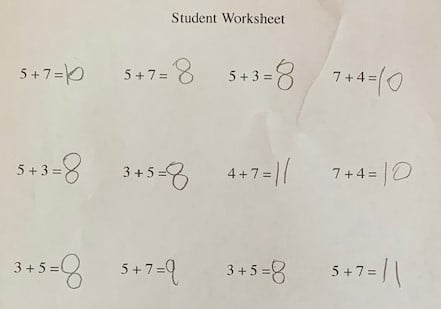
- Reverses numbers (e.g., 63 for 36)
- Gets lost in multi-step problems
- Trouble using a calculator
- Poor time and money management
- Cannot tell analog or digital time accurately
- Struggles to interpret graphs, charts, and measurements
- Avoids math-related games or real-world tasks
- Directional confusion: left/right, north/south
- Difficulty remembering sequences, historical timelines, or game rules
- Quickly gets lost in fast-moving games like football or chess
- Struggles with math vocabulary, rules, formulae, and processes
- May not understand why a strategy works, limiting knowledge transfer
- May develop math phobia or anxiety
🧠 Note: Persistent finger-counting alone isn’t a red flag—but if it continues into later grades, especially for simple tasks, it may indicate dyscalculia.
Dyscalculia symptoms and signs by age
Preschool (Ages 2–5)
- Struggles to count in order
- Difficulty sorting or matching by quantity or size
- Cannot link numbers to sets of objects (e.g., 3 blocks)
- Trouble remembering number-related songs or rhymes
Kindergarten to 2nd grade
- Trouble recognizing numbers
- Difficulty subitizing small groups
- Struggles with simple comparisons (more/less, bigger/smaller)
- Avoids counting tasks
3rd to 6th grade
- Difficulty with math facts and basic operations
- Relies heavily on fingers or visual aids
- Confused by word problems
- Trouble aligning numbers in columns
- Math-related anxiety becomes more visible
Middle school to high school
- Difficulty with multi-step problems
- Struggles with math in real-life contexts (budgets, cooking, distance)
- Trouble interpreting data, graphs, or geometry
- Limited problem-solving flexibility
- May avoid math-intensive subjects altogether
Adults with dyscalculia
Many adults with dyscalculia go undiagnosed for years. They often develop coping strategies or steer away from math-heavy careers. However, even in adulthood, these challenges can still impact daily life and self-confidence.
Typical signs in adults include:
- Difficulty estimating time, distance, or cost
- Struggling to split bills or calculate tips
- Anxiety about using ATMs, handling finances, or doing taxes
- Getting lost easily or struggling with directions and spatial orientation
- Trouble reading maps, schedules, or remembering appointments
- Confusion when reading charts, graphs, or working with spreadsheets
- Avoiding math tasks due to negative experiences in school
- Difficulty understanding measurements or interpreting numerical data at work
🧠 Note: Dyscalculia doesn’t disappear in adulthood—but with awareness and the right support, adults can build better strategies and reduce the impact on their daily lives.
Why it matters: Math skills in the real world
Imagine life without numbers:
You couldn’t tell time, follow a recipe, plan a trip, calculate discounts, or even know whether you received the right change. Math is woven into everyday life—and far more deeply than most people realize.
Without basic math skills, a person may struggle to:
- Manage personal finances (budgeting, banking, bills)
- Navigate public transport or read a timetable
- Follow a recipe or adjust ingredient quantities
- Understand contracts, interest rates, or loans
- Make sense of nutritional labels or medication dosages
- Use maps, GPS, or spatial reasoning
- Interpret charts, statistics, or election results
- Complete job-related tasks in fields like retail, healthcare, logistics, and construction
And yet, millions of children and adults silently struggle with these tasks due to dyscalculia.
In one study, as many as 6.4% of students were found to have developmental dyscalculia—a rate comparable to or even higher than dyslexia (Devine et al., 2013).
Despite this, dyscalculia remains underdiagnosed, underfunded, and often misunderstood. Between 2000 and 2010, the U.S. National Institutes of Health allocated $107.2 million to dyslexia research but just $2.3 million to dyscalculia (Butterworth et al., 2011).
Raising awareness is essential—because math matters. And recognizing the signs of dyscalculia is the first step to unlocking support.
Delve deeper
Want to learn more? Explore the following articles:
📊 Dyscalculia statistics
There is no general agreement on the precise meaning of the term dyscalculia. Therefore, reports of dyscalculia’s prevalence vary depending on the definition and situation. Research suggests it has the same prevalence as dyslexia (about 6–8% of children), although it is far less widely recognized by parents and educators.
👉 Dyscalculia types and subtypes
Dyscalculia refers to persistent and severe difficulties in learning math. This article explores its types and subtypes, including developmental, acquired, and functional classifications, as well as cognitive and behavioral subtypes proposed by researchers.
🧬 What causes dyscalculia?
Most problems can only be solved if one knows what causes that particular problem. A viable point of departure would thus be to ask: what causes dyscalculia? We investigate genetic influences, cognitive deficits, mathematical skills, and brain differences.
🛠️ Dyscalculia treatment and intervention
Dyscalculia treatment requires more than practice drills. This article outlines five effective, research-backed strategies that help children build foundational skills, reduce anxiety, and overcome math learning barriers.
Key takeaways
Talk to a specialist
If you suspect your child may have dyscalculia, do not wait. Getting the right help early can change the trajectory of their academic confidence and future.
Edublox offers cognitive training and live online tutoring to students with dyscalculia, including those with mild, moderate, or severe cases. Our programs go beyond traditional tutoring to target the root learning challenges behind math struggles.
We support families across the United States, Canada, Australia, and beyond.
Book a free consultation
Let’s talk about your child’s needs — and how we can help.
Dyscalculia Characteristics, Symptoms and Signs was authored by Sue du Plessis (B.A. Hons Psychology; B.D.), a dyscalculia specialist with 30+ years of experience in learning disabilities. Medically reviewed by Dr. Zelda Strydom (MBChB).
Bibliography and references for Dyscalculia Characteristics, Symptoms and Signs:
- Butterworth, B., Varma, S., & Laurillard, D. (2011). Dyscalculia: From brain to education. Science.
- Clements, D. H. (1999). Subitizing: What is It? Why teach it? Teaching Children Mathematics, 5(7).
- Devine, A., Soltesz, F., Nobes, A., Goswami, U., & Szűcs, D. (2013). Gender differences in developmental dyscalculia depend on diagnostic criteria. Learning and Instruction, 27:31–39.
- Hornigold, J. (2015). Dyscalculia pocketbook. Alresford, Hampshire: Teachers’ Pocketbooks.
- Peard, R. (2010). Dyscalculia: What is its prevalence? Research evidence from case studies. Procedia – Social and Behavioral Sciences, 8:106–113.
- Soares, N., Evans, T., & Patel, D. R. (2018). Specific learning disability in mathematics: A comprehensive review. Translational Pediatrics, 7(1):48–62.
- Sousa, D. A. (2015). How the brain learns mathematics, 2nd ed. California: Corwin Press.