
Reading is one of the most critical components of any language and an essential tool for lifelong learning. At its core, the goal of reading is comprehension.
Reading comprehension refers to a reader’s ability to interpret a text successfully. Mikulecky and Jeffries (2007) describe it as making sense of what readers encounter and connecting the ideas in the text to what they already know. Duffy (2009) goes further, defining comprehension as the very essence of reading, because if we do not understand the message, we are not truly reading.
At Edublox, we provide a basic reading comprehension program for schoolchildren and homeschoolers. © Edublox Pty (Ltd).
Table of contents:
Five components of reading comprehension
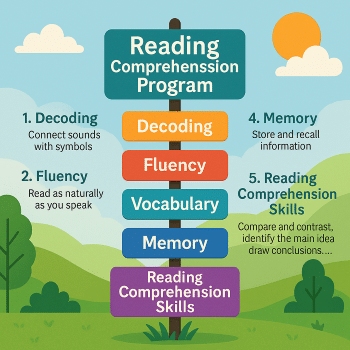
There are at least five components of reading comprehension:
1. Decoding
Decoding is the act of connecting sounds with symbols. To decode a word, a learner must know:
- which sound or sounds each letter makes, such as the /g/ in game and the /j/ sound in gym;
- how to take apart the sounds in a word and blend them. For example, in man, the first sound is /m/, the next sound is /ă/, and the last sound is /n/; and
- how groups of letters can work together to make a single sound, like ch in chip.
.
This skill is essential for proficient reading, but it is not enough on its own. Some words cannot be decoded easily, such as those whose spelling differs greatly from their sound — for example, enough. These words must be recognized instantly, almost like recognizing a face. High-frequency words (words that occur often) or words that need to be memorized in this way are called sight words.
2. Fluency
Another key component of comprehension is fluency. Fluency means being able to read as naturally as you speak.
Hudson, Lane, and Pullen (2005) describe fluent reading as having three elements: 1) accurate reading of connected text, 2) at a conversational rate, and 3) with appropriate prosody (expression).
Non-fluent readers typically struggle in at least one of these areas:
- They make frequent mistakes.
- They read too slowly.
- They read without appropriate expression or phrasing.
This makes intuitive sense. After all, it is difficult to understand someone who speaks haltingly or without natural intonation — and the same applies to reading.
3. Vocabulary
Being able to pronounce a word correctly does not guarantee that one understands its meaning. For example, correctly pronouncing the word archipelago will not help much when reading a passage about Lofoten, an archipelago of Nordland, Norway. It is essential that the reader also knows the meaning — in this case, “a group of islands.”
Decades of research confirm vocabulary’s crucial role in reading comprehension and in students’ overall academic success. Simply put, the larger a learner’s vocabulary, the better their chances of making sense of what they read.
4. Memory

Research using neuroimaging has shown that, while reading, the brain activity of children with reading comprehension problems differs from that of children with reading disabilities. Those with reading disabilities typically show abnormalities in the occipital-temporal cortex, a region associated with recognizing words on a page. By contrast, children with comprehension difficulties often show abnormalities in brain areas linked to memory.
Memory plays a vital role in reading comprehension:
- Short-term memory holds information in mind for only a few seconds while it is being processed.
- Long-term memory permanently stores processed information for later use.
- Working memory serves as the active system between the two. It allows us to hold and manipulate information as we read, making it possible to connect ideas across sentences and paragraphs.
.
Sentence comprehension, in particular, depends heavily on adequate working memory. Without it, readers may be able to decode words correctly yet still fail to grasp their meaning within a larger context.
5. Reading comprehension skills
Beyond decoding, fluency, vocabulary, and memory, learners also need to develop specific comprehension skills. These skills enable them to analyze, interpret, and respond to what they read. Examples include:
- Comparing and contrasting
- Identifying the main idea, important facts, and supporting details
- Sequencing events
- Analyzing characters, plots, and author’s purpose
- Drawing conclusions and making inferences
- Using context clues to understand new words
- Distinguishing between cause and effect
- Distinguishing between fact and opinion
- Predicting what will happen next
- Understanding similes, metaphors, and personification
These strategies equip learners to go beyond simply recognizing words on a page — they help transform reading into true understanding.
Basic reading comprehension program
The program below is designed for students who can already decode and read fluently, but who wish to improve their reading comprehension. If a child is still struggling with decoding and fluency, this program will likely be ineffective until those foundational skills are addressed.
Below are guidelines to help you get the maximum benefit from this program:
1. Study the program
The aim is to strengthen reading comprehension through exercises that improve memory, develop comprehension skills, and expand vocabulary.
2. Learn the exercises step by step
Once you have reviewed the program, read carefully how each exercise is carried out. Do not try to learn all of them at once.
Begin with Development Tutor. Once the learner is comfortable with it, introduce the other two exercises.
3. Find a quiet time and a quiet place
Choose a time that is relatively free from distractions, especially in the beginning, so the learner can concentrate fully.
4. Choose a suitable time of day
Early morning is often best, as it helps the learner organize their mind for the challenges ahead. If the program can only be done after school, ensure the learner has a short break before beginning.
Depending on your schedule, you may divide the lesson into two shorter sessions. For example, the learner could complete Development Tutor in the morning and the other exercises later in the afternoon.
5. Decide on the number of sessions per week
The program typically takes 40–50 minutes per lesson.
- Four sessions per week are ideal if the learner’s difficulties are severe.
- Three sessions per week may be sufficient if the problems are moderate.
- Two sessions per week are likely effective if there is no deficit and the learner simply wants to strengthen skills.
The guiding principle: the more time invested, the faster the progress.
6. Work with one child at a time
It is not recommended to work with two or more learners simultaneously, as this will reduce the effectiveness of the program.
Reading comprehension program:
1.) Development Tutor (15-25 minutes; 3 exercises)
Development Tutor is designed to strengthen cognitive skills, including short-term and working memory (see component no. 4 above). Each lesson consists of three exercises and takes about 20 minutes to complete.
Requirements:
- Windows 7 or newer, or most Mac computer using Google Chrome
- Compatible with Android tablets (minimum screen size: 10″; minimum screen resolution: FHD 1920×1080 or FHD+ 1920×1200)
Parental role:
Parents do not need to sit with their children during Development Tutor, but should keep an eye on them to ensure the exercises are being completed without using notes or other aids. An exception is the logical thinking exercise, where aids may be used.Adaptations:
For younger learners or those with very slow processing speed, the timer can be extended. It can be reset to normal after 2–3 months.2.) Reading comprehension exercise (15-25 minutes)
The purpose of this exercise is to develop reading comprehension skills (see component no. 5 above).
How it works:
The learner completes a reading comprehension worksheet. Thousands of free worksheets are available online. K5Learning.com, for example, offers exercises from 1st to 5th grade that are ideal for building comprehension.On the Edublox website, you will also find graded reading comprehension worksheets (graded with Readabilityformulas). Examples include:
- Four Amazing Rivers of the World (level 6)
- Five of the World’s Deserts (level 7)
- Eva Peron: From Humble Beginnings to First Lady (Part 1) (level 7)
- Dimash Kudaibergen: Rising Star Vocalist from Kazakhstan (level 8)
- Elon Musk: Innovator and Tech Guru (level 8)
- Planet Earth’s Seven Continents (level 9)
- Six Islands of the World (level 9)
- Jerusalema Dance Challenge (level 9)
- Reach for the Stars with Colonel Chris Hadfield (level 9)
- LEGO World Records: The Largest Caravan (level 10)
- One Ocean and Four — or Five — Basins (level 10)
- Mahatma Gandhi (level 10)
- Johnny Clegg: Musician and Philanthropist (level 12)
Start with easier passages, then gradually move to more challenging ones as the learner improves. Important: the passage and questions must be on separate pages.
Three steps to follow:
- The learner first reads the passage before looking at the questions. They may read it several times. Once they begin answering, however, they may not reread the passage or search for answers. All questions must be answered from memory. Answers are written in gray pencil.
- Next, the learner rereads the passage, checking their answers and making corrections with a blue pen (they may now flip between passage and questions).
- Finally, the learner uses the answer sheet to mark their original answers (those written in gray pencil), awarding themselves marks in red pen. Only half-marks may be given for answers corrected in blue.
3.) Vocabulary exercise (10-15 minutes)
This exercise is designed to expand the learner’s vocabulary (see component no. 3 above).
How it works:
Select three to five unfamiliar words from each reading comprehension worksheet. Create word cards with the word on the front and its definition on the back.For example:
- Front: archipelago
- Back: a group of islands
The learner studies the cards each session. With every new worksheet, add three to five new cards to the pile. Regularly review older cards to reinforce retention. Ask simple questions to test recall, such as:
- “What is an archipelago?”
- “Give me one word for a group of islands.”
Final note:
This program will only produce lasting results if applied consistently over an extended period. Progress in reading comprehension, like Rome, is not built in a day.
Edublox offers cognitive training and live online tutoring to students with dyslexia, dysgraphia, dyscalculia, and other learning difficulties. Our students are based in the United States, Canada, Australia, and many other parts of the world. Book a free consultation to discuss your child’s learning needs and how we can help.
This Reading Comprehension Program was compiled by Sue du Plessis (B.A. Hons Psychology; B.D.), an educational specialist with 30+ years of experience in learning disabilities. © Edublox Pty (Ltd).
References for Reading Comprehension Program:
- Duffy, G. G. (2009). Explaining reading: A resource for teaching concepts, skills, and strategies (2nd ed.). New York, NY: Guilford Press.
- Hudson, R. F., Lane, H. B., & Pullen, P. C. (2005). Reading fluency assessment and instruction: What, why, and how? The Reading Teacher, 58(8): 702–14.
- Mikulecky, B. S., & Jeffries, L. (2007). Advanced reading power. Pearson Education.