Skip to content
Help for learning disabilities
Home
Products & Services
Success Stories
Resources
Dyslexia
Dyscalculia
Cognitive Skills
Reading and Learning Research
Edublox Explained
Edublox Research
Top Success Stories
All Articles
About
About Us
Contact Us
Contact us
Home
Products & Services
Success Stories
Resources
Dyslexia
Dyscalculia
Cognitive Skills
Reading and Learning Research
Edublox Explained
Edublox Research
Top Success Stories
All Articles
About
About Us
Contact Us
Contact us
Sign In
Free Consultation
Register
LD Articles, Resources and Success Stories
Search
Filter by category
All
All
Attention Deficits and ADHD
Cognitive Skills and Study Methods
Dyscalculia and Math Difficulties
Dysgraphia and Writing Problems
Dyslexia and Reading Difficulties
Edublox in the Press and Edublox News
Edublox Research
IQ, Intelligence and Brain Power
Kids' Health
Language Development and Language Learning
Overcoming Learning Barriers: Ask Sue for Help
Overcoming Learning Barriers: Top Success Stories
Parenting, Home and Family
Reading and Learning Research
Teaching Resources
Uncategorized
Unusual and Amazing
What's on for Breakfast, Lunch and Supper?
1
2
3
60
Dyscalculia and Math Difficulties
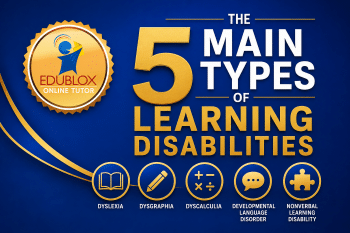
The 5 Main Types of Learning Disabilities
Learning disabilities are more than academic struggles. They are neurologically based difficulties that can affect reading, writing, mathematics, language, and reasoning. This article explores the five main types of learning disabilities—dyslexia, dysgraphia, dyscalculia, developmental language disorder, and nonverbal learning disability.
Read more...
Parenting, Home and Family
10 Conditions That Can Affect Learning
Why does one child struggle with reading while another battles with math, attention, or language? This parent-friendly guide explains 10 common conditions that can affect learning, including dyslexia, dysgraphia, dyscalculia, ADHD, autism, dyspraxia, and processing disorder
Read more...
Dyslexia and Reading Difficulties
Landmark Studies in Dyslexia Research
What transformed dyslexia from a mysterious reading problem into one of the most researched learning difficulties in the world? Explore the landmark studies and researchers that shaped modern understanding of dyslexia over the past century.
Read more...
Dyslexia and Reading Difficulties
Comorbidity of Dyslexia: 5 Related Disorders
Dyslexia rarely travels alone. Many children and adults with dyslexia also experience difficulties with mathematics, handwriting, word retrieval, coordination, or attention.
Read more...
Dyslexia and Reading Difficulties
The Dyslexia Debate and the Reality of Reading Failure
Is dyslexia a neurological condition, a learning difference, a gift, a myth, or simply the result of poor instruction? While experts continue to debate the label, one fact remains undeniable: some children experience extraordinary difficulty learning to read. This article explores the dyslexia debate, the devastating consequences of reading failure, and why there is reason for hope.
Read more...
Dyslexia and Reading Difficulties
Dyslexia Theories and Models
Explore six major dyslexia theories and models, from the discrepancy model and phonological deficit theory to the multiple deficit model. Learn how scientific thinking about dyslexia has evolved and why many researchers now view dyslexia as a multifaceted learning difficulty.
Read more...
Teaching Resources
Sight Words: What Are They? High-Frequency Word Lists
What are sight words, and why are they important for reading fluency? Learn the difference between sight words and high-frequency words, explore the Dolch and Fry word lists, and discover how children build a sight-word vocabulary.
Read more...
Dyslexia and Reading Difficulties
18 Facts About Dyslexia Every Parent Should Know
Dyslexia is more than letter reversals and slow reading. It is a complex learning difficulty with multiple causes and many possible symptoms—but with the right support, success is possible. Here are 18 essential facts every parent, teacher, and advocate should know.
Read more...
Cognitive Skills and Study Methods
Processing Speed Deficits: Signs, Symptoms, and Treatment
Slow processing speed can make learning, reading, writing, and completing schoolwork more difficult. Learn the signs, causes, and ways to improve this important cognitive skill.
Read more...
Dyslexia and Reading Difficulties
Orthographic Processing Disorder: When Reading Never Becomes Automatic
Orthographic Processing Disorder affects the brain’s ability to store and retrieve written words automatically. Learn the signs, causes, and how targeted intervention can improve reading fluency and spelling.
Read more...
Dyslexia and Reading Difficulties
17 Dyslexia Success Stories from Real Families
Not all dyslexia success stories involve celebrities. These real-life stories of ordinary children and teens overcoming reading struggles prove that with the right support, progress is possible.
Read more...
Dyslexia and Reading Difficulties
Orthographic Processing and Orthographic Mapping
Many children with dyslexia can sound out words correctly yet still struggle to become fluent readers. This article explains orthographic processing, orthographic mapping, the VWFA, and the cognitive skills involved in automatic word recognition and fluent reading development.
Read more...
1
2
3
60
Contact Us
We use cookies to ensure that we give you the best experience on our website. If you continue to use this site we will assume that you are happy with it.

Ok
Privacy policy