
The term dyscalculia — from the Greek dys (meaning “bad”) and Latin calculia (meaning “to count”) — means “to count badly.” It describes individuals with persistent and severe difficulties understanding numbers and performing basic arithmetic.
Compared to other learning disabilities like dyslexia, dyscalculia has received far less attention. Public awareness remains limited, even though it can significantly affect a child’s academic progress and self-esteem. Yet early diagnosis and targeted intervention are critical to reduce its long-term impact.
In this article, we explore why early treatment matters, outline five essential strategies that should be part of any effective dyscalculia intervention plan, and explain how Edublox supports children in overcoming math-related learning challenges.
Table of contents:
- What is dyscalculia?
- Early intervention for dyscalculia is best
- Five strategies for dyscalculia treatment
- How Edublox dyscalculia treatment works
- Dyscalculia case studies
- Delve deeper
- Key takeaways
- Talk to a specialist
What is dyscalculia?
Dyscalculia is a specific learning disability that affects a person’s ability to understand numbers and perform mathematical tasks. It is characterized by persistent difficulties in learning basic arithmetic facts, grasping numerical quantities, and carrying out accurate and fluent calculations. These challenges are unexpected in relation to the person’s age and are not the result of poor instruction or low intellectual ability.
Children with dyscalculia often struggle to retrieve math facts from memory. Instead of recalling answers automatically, they may rely on immature strategies such as finger counting, long after their peers have moved on to more efficient methods. These difficulties typically persist despite repeated instruction and practice, making it challenging for students to keep pace as math concepts become increasingly complex. Without early, targeted intervention, the gap tends to widen over time.
Early intervention for dyscalculia is best
Dyscalculia can have profound implications if left unaddressed — not only academically, but emotionally and socially as well. Children who struggle consistently with math may begin to feel isolated, frustrated, and ashamed. In a focus group conducted by Bevan and Butterworth (2007), children with dyscalculia described feeling left out, blamed themselves for not understanding tasks, and expressed emotions such as sadness, anger, and a deep sense of inadequacy.
As these struggles continue, the effects often spill over into everyday life. Children who grow into adulthood without intervention may face challenges with tasks such as remembering phone numbers and dates, calculating change while shopping, managing time, or planning appointments. Seemingly simple tasks can become sources of embarrassment or anxiety.
Research suggests that math difficulties have a more profound impact on long-term outcomes than reading challenges. According to Bynner and Parsons (1997), individuals with poor numeracy skills are more likely to leave school early, face unemployment, experience depression and health problems, and even encounter legal trouble. The cost of doing nothing can be high, both for the individual and for society as a whole.
Even mild delays in math learning can snowball over time. This widening gap is known as the “Matthew Effect,” a term coined by Robert K. Merton in 1968 based on a biblical verse: “For to everyone who has, more will be given… but from the one who has not, even what he has will be taken away.” In education, this means that children who fall behind early often fall further and further behind — unless targeted intervention breaks the cycle.
Five strategies for dyscalculia treatment
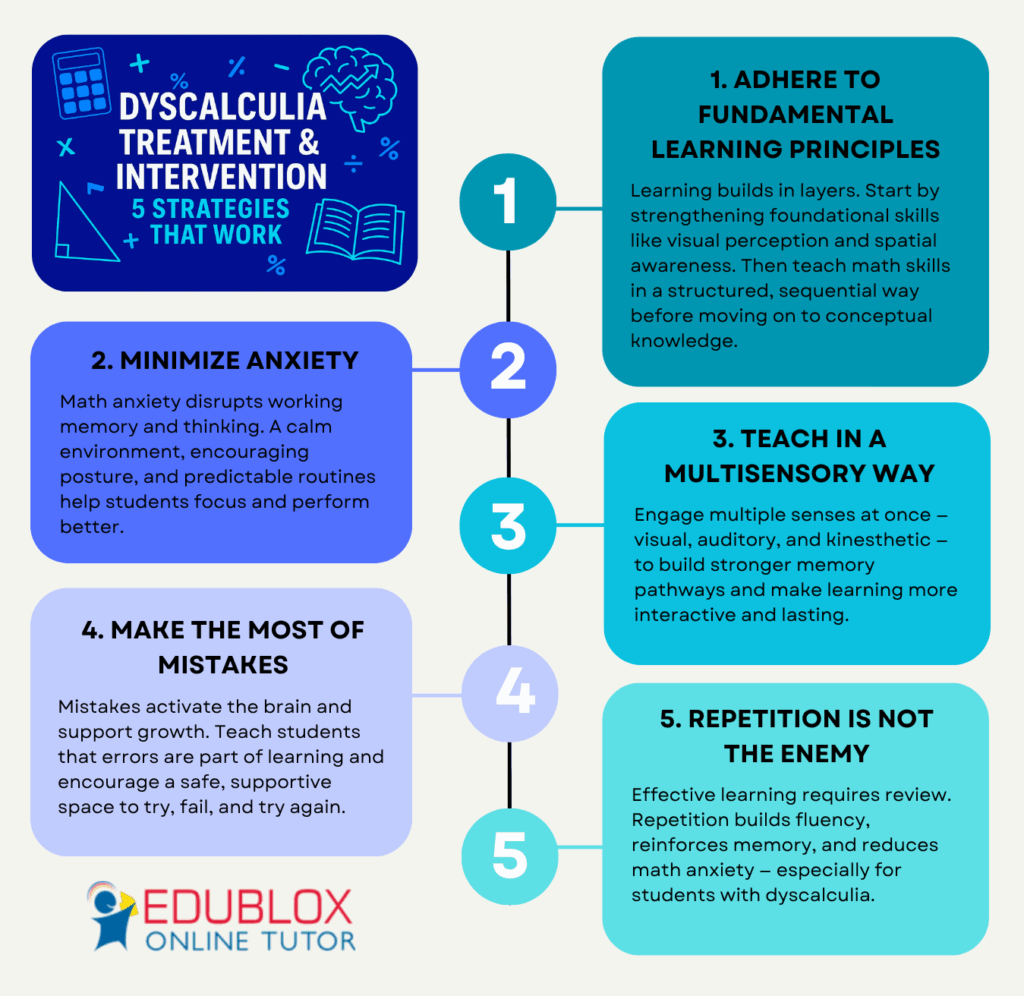
Like other learning differences, dyscalculia cannot be treated with medication. Instead, specialized learning strategies are required to address the underlying difficulties and support meaningful progress. Below are five key strategies that should be part of any effective dyscalculia treatment plan:
1. Adhere to fundamental learning principles
Learning is a layered process. Certain foundational skills must be mastered first before more advanced skills and knowledge can be learned and developed, and mathematics is no exception.
To play soccer, a person must first learn the basics, such as passing, dribbling, and shooting. Without these core skills, no amount of coaching in strategy or teamwork will make them a competent player. Similarly, to succeed in math, a child must begin by mastering foundational cognitive skills — including visual perception, spatial awareness, and visual and working memory. For example, a child who confuses the symbols +, –, ÷, and × may struggle with visual discrimination. A child with poor spatial skills may struggle with aligning numbers and drawing number lines.
The second step would be to master mathematical skills, which must be learned sequentially. One has to learn to count before it becomes possible to learn to add and subtract. Suppose one tried to teach a child who had not yet learned to count to add and subtract. This would be impossible, and no amount of effort would ever succeed in teaching the child these skills. The child must learn to count first before it becomes possible for them to learn to add and subtract.
The third step would be to ensure the child catches up on the knowledge aspect of math, for example, understanding how place value works, knowing the difference between a square and a rectangle, or recognizing that two parallel lines will never meet.
2. Minimize anxiety
It is essential to minimize anxiety as part of any dyscalculia intervention plan. Anxiety can become a learning barrier in its own right, interfering with focus, memory, and problem-solving. Research has shown that math anxiety can impair working memory — the mental space used to hold and manipulate information — making it harder for students to process numerical tasks, even when they understand the content (Ashcraft et al., 1998).
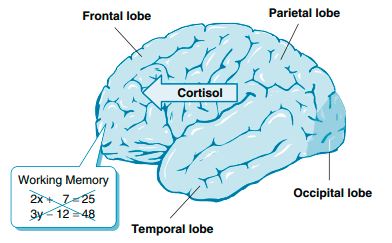
When students feel anxious, the brain releases the hormone cortisol, which activates the body’s stress response. Heart rate increases, breathing becomes shallow, and the frontal lobe — the brain’s center for higher-order thinking — shifts its focus from learning to self-protection. In this state, even simple math tasks can feel overwhelming.
One practical way to reduce anxiety is by encouraging good posture. In a study by researchers at San Francisco State University, students were asked to perform a mental math task — subtracting 7 from 843 repeatedly — while either slumped forward or sitting upright. The results were striking: 56 percent of students found the task easier when sitting up straight (Peper et al., 2018). For learners who feel anxious about math, posture alone can make a significant difference in how clearly they think and how confidently they approach problems.
Creating a calm, structured learning environment, breaking tasks into manageable steps, and celebrating small wins can also help reduce anxiety and build confidence — both essential for success in math.
3. Teach in a multisensory way
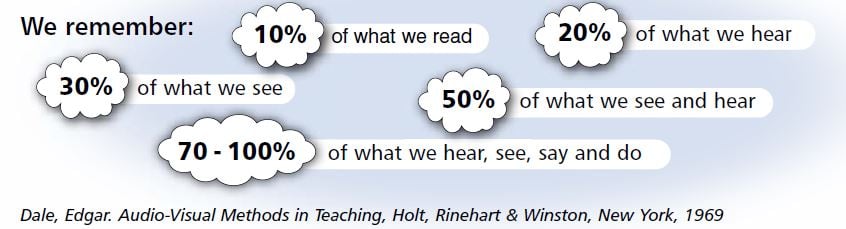
For students with dyscalculia, relying solely on one pathway for learning — such as listening to explanations or copying from the board — is often insufficient. Teaching in a multisensory way means engaging multiple senses at once to help information stick. This is especially helpful when one or more sensory channels (visual, auditory, or kinesthetic) are underdeveloped or overloaded by anxiety.
Multisensory instruction combines visual (seeing), auditory (hearing), and kinesthetic (moving/touching) input simultaneously. For example, a student might say a number aloud (auditory), write it with their finger in the air or sand (kinesthetic), and see it on a card or screen (visual) — all at the same time.
By engaging multiple senses, stronger pathways are formed in the brain. The learner’s stronger channels support the weaker ones (Hornigold, 2015), making it easier to retain and recall information. This approach is especially valuable for students with dyscalculia, who may struggle to process symbols and quantities using traditional, single-channel instruction.
Multisensory teaching is not just for early learners — older students benefit as well. For instance, using manipulatives like fraction tiles or counting blocks can help clarify abstract concepts. Tapping rhythmically when skip-counting, walking a number line, or color-coding steps in a multi-part problem are all effective ways to reinforce understanding.
When used consistently, multisensory instruction not only improves learning outcomes but also boosts confidence by making math feel more tangible, interactive, and manageable.
4. Make the most of mistakes
Mistakes are a natural and essential part of learning, especially in math. However, for students with dyscalculia, constant mistakes can lead to frustration, avoidance, and a deep sense of failure. Over time, this can erode confidence and motivation. That is why it is so important to change the way we, as educators and parents, talk about mistakes in the learning process.
Research by Jo Boaler and Carol Dweck at Stanford University has shown that making mistakes promotes brain growth. When students struggle and make errors, the brain becomes more active. Even if the mistake is not corrected immediately, neural connections still form, thereby strengthening the learning process. In contrast, getting the answer right without effort produces little to no cognitive growth.
The key is to reframe mistakes as opportunities, not as signs of failure. When students understand that struggling is a natural part of the learning process, they begin to approach math with greater resilience and curiosity. Instead of avoiding problems they might get wrong, they are more likely to engage and persist.
One of the most powerful moves a teacher or parent can make is to shift the messaging around errors: praise the effort, highlight what the student did right, and guide them gently toward discovery. A classroom or home where it is safe to make mistakes becomes a space where real learning can happen.
5. Repetition is not the enemy
In the 1920s and 1930s, repetition and rote learning came to define bad teaching. Teachers were informed that drill-and-practice can dull students’ creativity (Heward, 2003) and that rote learning in math classes is anti-right-brain, potentially limiting students’ ability to develop their full potential (Elliott, 1980). The phrase “drill and kill” is still used in educational circles, meaning that drilling students can kill their motivation to learn (Heffernan, 2010).
However, for students with dyscalculia, repetition is not harmful — it’s essential.
When properly conducted, drill-and-practice is a consistently effective teaching method. It reinforces patterns, builds automaticity, and frees up working memory, enabling students to focus on problem-solving rather than relying on basic recall. Like a violinist who practices scales or an athlete who repeats drills, a child learning math needs repeated exposure to build fluency and confidence. This type of focused repetition is not “low level” — it is foundational to high-level performance in any field (Brophy, 1986).
A meta-analysis of 85 academic intervention studies with students with learning disabilities, carried out by Swanson and Sachse-Lee (2000), found that the largest effect sizes were obtained by interventions that included systematic drill, repetition, practice, and review — regardless of the study’s theoretical approach.
How Edublox dyscalculia treatment works
Edublox offers online intervention for students with mild to severe dyscalculia. The program targets three core areas:
- Developing foundational cognitive skills that support math learning, such as visual-spatial memory, working memory, sequencing, and logical thinking..
- Teaching math skills in a sequential, structured way. Students begin with counting in 1s and multiples (2, 3, 4, 5, 10, 6, 7, 8, 9, 11, 12, 15, and later 20 and 25). This lays the foundation for multiplication and division, which are integrated into the process of counting. Addition and subtraction are introduced through mental math..
- Building procedural fluency and math knowledge. Students progress through operations involving whole numbers — including addition, subtraction, multiplication, and long division — before moving on to fractions and mixed numbers. Instruction continues with order of operations, decimals, percentages, and integers. Place value is developed from early on, extending to the hundred millions, and tenths, hundredths, and thousandths are added before decimals are formally introduced..
The program also applies the key strategies outlined in this article, including reducing anxiety, teaching in a multisensory manner, utilizing repetition, and helping students learn from their mistakes.
Dyscalculia case studies
Six years of teaching and tutoring failed to help Hannah, who had severe dyscalculia. Her mother, Robyn — a family physician — discovered the Edublox system and decided to give it a try. In a video testimonial, Robyn explains how the program transformed her daughter’s learning and confidence. She volunteered to share her story because, in her words, “Edublox has changed my daughter’s life.”
Sandy shares a similar experience with her daughter, Amy, who was diagnosed with both dyscalculia and dyslexia. In her video, Sandy describes how Edublox helped fill in the gaps Amy was missing: from working memory and number sense to understanding price tags and everyday math.
Veronica, another student, struggled with both reading and mathematics due to dyspraxia. Her father recounts how the Edublox math program helped her gain confidence, build critical skills, and access learning in a way that finally made sense.
Final thoughts
Dyscalculia can be a lifelong challenge, but it does not have to be a lifelong barrier. With the proper intervention, targeted strategies, and consistent support, students with dyscalculia can not only improve their math skills but also rebuild their confidence and sense of capability. Early action makes a world of difference — and it is never too soon to start. Every child deserves the chance to succeed in math and life.
Delve deeper
Want to learn more? Explore the following articles:
🧠 Dyscalculia characteristics, symptoms, and signs
In this article, we explore the characteristics, symptoms, and signs of dyscalculia—what to look for at various ages, how it impacts everyday life, and why early identification is crucial. Recognizing the signs early can make a world of difference.
📊 Dyscalculia statistics
There is no universal definition of dyscalculia, so prevalence estimates vary. Research suggests it affects roughly 6–8% of children—similar to dyslexia—but is far less recognized by parents and educators.
👉 Dyscalculia types and subtypes
Dyscalculia refers to persistent and severe difficulties in learning math. This article explores its types and subtypes, including developmental, acquired, and functional classifications, as well as cognitive and behavioral subtypes proposed by researchers.
🧬 What causes dyscalculia?
To solve a problem, we must first understand its cause. This section explores genetic influences, brain differences, cognitive deficits, and foundational mathematical skill gaps as potential contributors.
Key takeaways
Talk to a specialist
If you suspect your child may have dyscalculia, do not wait. Getting the right help early can change the trajectory of their academic confidence and future.
Edublox offers cognitive training and live online tutoring to students with dyscalculia, including those with mild, moderate, or severe cases. Our programs go beyond traditional tutoring to target the root learning challenges behind math struggles.
We support families across the United States, Canada, Australia, and beyond.
Book a free consultation
Let’s talk about your child’s needs — and how we can help.
Dyscalculia Treatment & Intervention: 5 Strategies that Work was authored by Sue du Plessis (B.A. Hons Psychology; B.D.), a dyscalculia specialist with 30+ years of experience in learning disabilities and medically reviewed by Dr. Zelda Strydom (MBChB).
References for Dyscalculia Treatment & Intervention: 5 Strategies that Work:
- Ashcraft, M. H., Kirk, E. P., & Hopko, D. R. (1998). On the cognitive consequences of mathematics anxiety. In C. Donlan (Ed.), The development of mathematical skills (pp. 175–196). Hove, England: Psychology Press.
- Bevan, A., & Butterworth, B. (2002). The responses of students and teachers to math disabilities in the classroom. Institute of Cognitive Neuroscience, University College London.
- Boaler, J. (2016). Mathematical mindsets: Unleashing students’ potential through creative math, inspiring messages and innovative teaching. San Francisco, CA: Jossey-Bass.
- Brophy, J. (1986). Teacher influences on student achievement. American Psychologist, 41(10), 1069–1077.
- Elliott, P. C. (1980). Going ‘back to basics’ in mathematics won’t prove who’s ‘right’, but who’s ‘left’ (brain duality and mathematics learning). International Journal of Mathematical Education in Science and Technology, 11(2), 213–219.
- Heffernan, V. (2010, September 16). Drill, baby, drill. The New York Times Magazine. Retrieved July 1, 2025 from https://www.nytimes.com/2010/09/19/magazine/19fob-medium-heffernan-t.html
- Heward, W. L. (2003). Ten faulty notions about teaching and learning that hinder the effectiveness of special education. Journal of Special Education, 36(4), 186-205.
- Hornigold, J. (2015). Dyscalculia pocketbook. Alresford, Hampshire: Teachers’ Pocketbooks.
- Parsons, S., & Bynner, J. (2005). Does numeracy matter more? National Research and Development Centre for Adult Literacy and Numeracy (NRDC).
- Peper, E., Harvey, R., Mason, L., & Lin, I.-M. (2018). Do better in math: How your body posture may change stereotype threat response. NeuroRegulation, 5(2), 67–74.
- Sousa, D. A. (2015). How the brain learns mathematics (2nd ed.). Thousand Oaks, CA: Corwin Press.
- Swanson, H. L., & Sachse-Lee, C. (2000). A meta-analysis of single-subject design intervention research for students with LD. Journal of Learning Disabilities, 38(2), 114-36.