

In 1969, Laszlo Virag was tried and convicted of committing armed robberies in Liverpool and Bristol. Several eyewitnesses identified him from lineups or recognized him from photographs. One police officer even testified, “his face is imprinted in my brain.”
But the real perpetrator turned out to be someone else — George Payen — a man who bore a vague resemblance to Mr. Virag. In 1974, after years of wrongful imprisonment, Virag was officially pardoned. His case remains a chilling example of how mistaken visual memory can lead to a devastating miscarriage of justice — and a reminder that visual memory is not simply about remembering what we see, but about accurately storing and retrieving visual information.
Table of contents:
- What is visual memory?
- Types of visual memory
- Why visual memory matters for academics
- Visual memory can be trained
- Improving visual memory
- Key takeaways
What is visual memory?
Memory is the process by which information is encoded, stored, and later retrieved. While we often think of memory as a single mental faculty, it actually comes in many forms — each with its own role and characteristics.
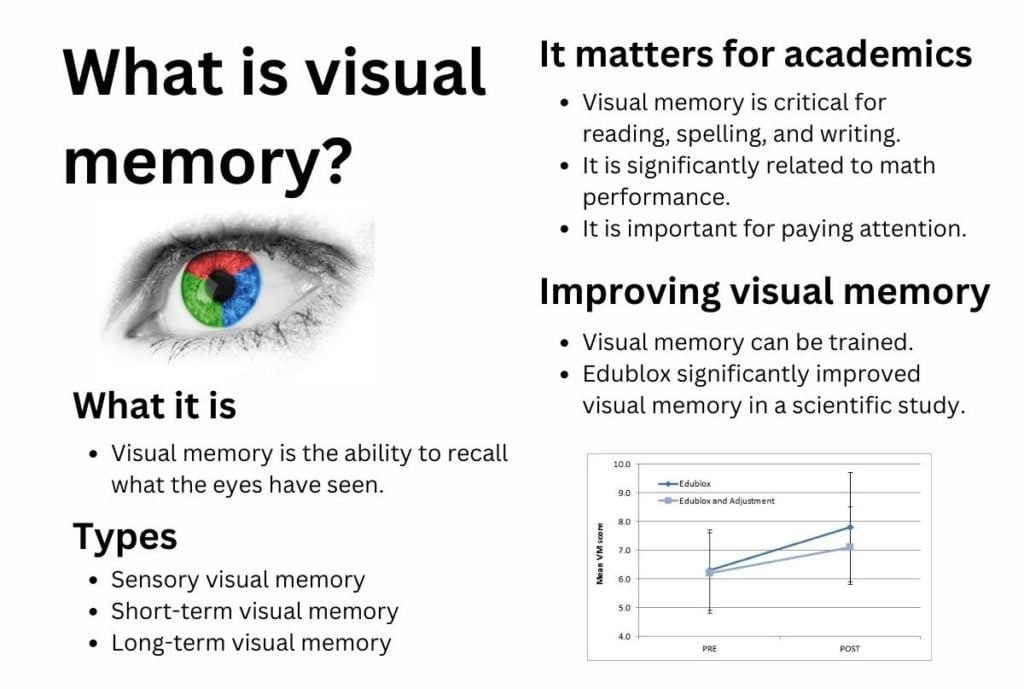
Visual memory refers to the ability to remember what we’ve seen. It involves storing and later recalling visual information — images, shapes, scenes, or written words — even when those visual stimuli are no longer present. In short, it’s how the brain retains and retrieves what the eyes have observed.
Types of visual memory
Researchers typically divide visual memory into three main subsystems: sensory, short-term, and long-term memory. Each plays a different role in how we process and retain what we see.
1. Sensory visual memory
Sensory visual memory — also called iconic memory — is the briefest form of visual memory. You can experience it by standing in a dark room, taking a photo with a flash, and noticing how the image of the room lingers for a moment even after the light fades. This fleeting afterimage lasts only about half a second, yet it serves as the foundation for all subsequent visual processing.
2. Short-term visual memory
Visual short-term memory (STM) retains visual information for several seconds, supporting cognitive tasks such as comparing images or copying from the board. These mental representations are more abstract and durable than those in iconic memory, but still temporary.
Visual STM is distinct from verbal STM, which holds language-based information. The two systems function independently — a person can have deficits in one but not the other. For example, brain injury might impair visual STM without affecting verbal memory.
A related concept, visual working memory (WM), goes a step further. While visual STM refers to briefly storing visual information, visual WM also includes manipulating that information — such as rotating an image in your mind or remembering the sequence of a pattern.
3. Long-term visual memory
Visual long-term memory stores images, scenes, and visual details over extended periods — from days to years. Its capacity appears to be vast. In one classic study, participants who viewed 600 photographs could still recognize 92% of them a day later and 63% even after a year. This remarkable endurance is captured in the contrast between two landmark studies: “The Magical Number 4 in Short-Term Memory” (Cowan, 2001) versus “Learning 10,000 Pictures” (Standing, 1973).
Why visual memory matters for academics
It is often claimed that up to 80% of learning happens through the eyes. While the exact percentage is debated, few would question that visual memory plays a vital role in academic success across subjects — from reading and writing to mathematics and even attention regulation.
1. Essential for reading, spelling, and writing
Children with underdeveloped visual memory skills often struggle to remember and reproduce what they have seen — such as a word on a page or letters on a chalkboard. This can make it difficult to:
- Recall the overall visual appearance of words
- Remember the order of letters in a word
- Copy words or sentences accurately
- Develop a large sight-word vocabulary through orthographic mapping
They might remember some letters but not their sequence, or they might recognize the first letter without grasping the rest. As a result, these children often face severe spelling difficulties and fail to build automaticity in reading.
Writing can be equally frustrating. Children with visual memory deficits may write slowly, reverse letters, or mix up words in a sentence. Copying from a board or book can become an exhausting and error-prone task — especially during worksheets, tests, or timed activities.
2. Significantly related to math performance
In a study at The Ohio State University College of Optometry, Kulp et al. (2004) tested 171 children (mean age: 10.08 years) to determine whether visual-perception skills could predict math achievement. They assessed two components:
- Visual discrimination: the ability to notice fine differences in shape, size, orientation, or color
- Visual memory: the ability to retain and recall visual details
Their conclusion was striking:
“Poor visual perceptual ability is significantly related to poor achievement in mathematics, even when controlling for verbal cognitive ability… particularly visual memory should be considered to be amongst the skills that are significantly related to mathematics achievement.”
Further support comes from a large study by Szűcs and colleagues (2013) at the University of Cambridge. They studied over 1,000 nine-year-olds while investigating the roots of developmental dyscalculia — a severe math learning difficulty that affects about 6% of children. The researchers found that children with dyscalculia consistently performed poorly on visual-spatial memory tasks, such as recalling the location of objects placed in a grid.
In short, children who struggle to remember visual information may find it harder to grasp math concepts, recall number patterns, or perform calculations. They may also struggle with place value, written procedures, and recognizing numerical patterns.
3. Important to paying attention
Visual memory also plays a role in maintaining focus and attention. In a study by Lufi and Cohen (1985), researchers compared the visual short-term memory (STM) of children with Attention Deficit Disorder (ADD) to that of children with emotional difficulties. The children with ADD scored significantly lower on visual STM tasks — reinforcing the idea that visual memory plays a key role in sustained attention and mental tracking.
However, despite its importance, visual memory is rarely assessed in standard intelligence or achievement tests. That leaves many children struggling simply because this core skill has not been measured or strengthened.
Visual memory can be trained

Research suggests that visual memory can be improved, and a classic study by Kleinfeld (1973) offers compelling evidence.
Kleinfeld assessed the visual memory of two distinct groups: 501 urban Caucasian children and 125 Indigenous Alaskan children living in remote villages. The results were striking: the village children consistently outperformed their urban counterparts on visual memory tasks. Visual memory also showed a clear improvement with age.
What explains the difference?
Unlike the vibrant, varied landscapes of cities, the Arctic environment is visually uniform — endless snowfields, flat tundra, and piled sea ice. For generations, Indigenous hunters have relied on their ability to notice and remember the subtlest visual cues: a slightly upturned rock, a snowdrift’s edge, or the position of the Big Dipper at a particular hour. These minute details, invisible to outsiders, became critical for finding game and navigating back home.
Visitors often marveled at the local people’s ability to navigate across what appeared to be featureless terrain. However, this was not magic — it was trained attention and practiced visual memory.
Kleinfeld’s findings demonstrate a powerful truth: visual memory is not fixed — it can be sharpened through necessity, experience, and practice.
Improving visual memory
At Edublox, we know that visual memory isn’t just important — it’s trainable.
Edublox offers multisensory cognitive training designed to help students overcome learning challenges and reach their full potential. Backed by more than 30 years of experience and pedagogical research, Edublox targets the underlying cognitive skills that underpin academic success — including visual memory.
These skills are often the root cause of difficulties in reading, spelling, writing, and math. Through targeted exercises, Edublox strengthens these weak areas, resulting in meaningful and measurable improvements in learning performance.
A closer look: The Mays study
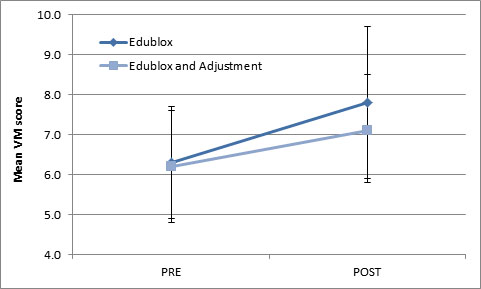
A study led by Dr. Jaidan Mays, a chiropractor, investigated the effect of Edublox on visual memory in school-aged children. The study involved 34 students in Grades 5 to 7 from an inner-city school. Visual memory and visual sequential memory were assessed using two subtests from the Test of Visual Perceptual Skills.
Students were divided into two equal groups:
- The Edublox Group received 22.5 hours of Edublox training over five days
- The Edublox + Adjustment Group received the same Edublox training, along with daily cervical spinal manipulative therapy
After five days, both groups showed significant improvement. The average visual memory age across all participants jumped from 6.2 years to 7.5 years — a gain of 1.3 years in just five days. Interestingly, the Edublox-only group outperformed the group that also received spinal adjustments:
- Edublox Group: from 6.3 to 7.8 years
- Edublox + Adjustment Group: from 6.2 to 7.1 years
Who is Edublox for?
Edublox supports both gifted and struggling learners. The program has proven effective in alleviating symptoms of dyslexia, dyscalculia, and dysgraphia, thanks in large part to its focus on strengthening foundational cognitive skills, such as visual memory.
Key takeaways
Edublox provides support for students with dyslexia, dyscalculia, and other learning difficulties. We help students worldwide overcome academic challenges and reach their full potential. Book a free consultation to discuss your child’s learning needs and discover how we can help.
References for What Is Visual Memory? Types, Importance, Improving:
- Cowan, N. (2001). The magical number 4 in short-term memory: A reconsideration of mental storage capacity. Behavioral and Brain Sciences, 24(1), 87–114.
- Kleinfeld, J. S. (1973). Intellectual strengths in culturally different groups: An Eskimo illustration. Review of Educational Research, 43(3), 341–359.
- Kulp, M. T., Earley, M. J., Mitchell, G., Edwards, K. E., Timmerman, L. M., Frasco, C. S., & Geiger, M. (2001). Are visual perceptual skills related to mathematics ability in second through sixth grade children? Focus on Learning Problems in Mathematics, 23(4), 44–57.
- Lufi, D., & Cohen, A. (1985). Attentional deficit disorder and short-term visual memory. Journal of Clinical Psychology, 41(2), 265–267.
- Mays, J. L. (2014). Effects of Edublox training versus Edublox training combined with cervical spinal manipulative therapy on visual memory (Master’s thesis, University of Johannesburg).
- Standing, L. (1973). Learning 10,000 pictures. Quarterly Journal of Experimental Psychology, 25(2), 207–222.
- Szűcs, D., Devine, A., Soltesz, F., Nobes, A., & Gabriel, F. (2013). Developmental dyscalculia is related to visuo-spatial memory and inhibition impairment. Cortex, 49(10), 2674–2688.
What Is Visual Memory? Types, Importance, Improving was authored by Sue du Plessis (B.A. Hons Psychology; B.D.), an educational specialist with 30+ years of experience in the learning disabilities field.
Edublox is proud to be a member of the Institute for the Advancement of Cognitive Education (IACE), an organization dedicated to improving learning through cognitive education and mediated learning approaches.