Skip to content
Help for learning disabilities
Home
Products & Services
Success Stories
Resources
Dyslexia
Dyscalculia
Cognitive Skills
Reading and Learning Research
Edublox Explained
Edublox Research
Top Success Stories
All Articles
About
About Us
Contact Us
Contact us
Home
Products & Services
Success Stories
Resources
Dyslexia
Dyscalculia
Cognitive Skills
Reading and Learning Research
Edublox Explained
Edublox Research
Top Success Stories
All Articles
About
About Us
Contact Us
Contact us
Sign In
Free Consultation
Register
LD Articles, Resources and Success Stories
Search
Filter by category
All
All
Attention Deficits and ADHD
Cognitive Skills and Study Methods
Dyscalculia and Math Difficulties
Dysgraphia and Writing Problems
Dyslexia and Reading Difficulties
Edublox in the Press and Edublox News
Edublox Research
IQ, Intelligence and Brain Power
Kids' Health
Language Development and Language Learning
Overcoming Learning Barriers: Ask Sue for Help
Overcoming Learning Barriers: Top Success Stories
Parenting, Home and Family
Reading and Learning Research
Teaching Resources
Uncategorized
Unusual and Amazing
What's on for Breakfast, Lunch and Supper?
Showing articles with tag:
dyslexia-causes
|
Clear
Overcoming Learning Barriers: Ask Sue for Help
Is Dyslexia Incurable? – Ask Sue
A parent asks if dyslexia is truly incurable after their child’s diagnosis. Sue explains what research shows about neuroplasticity, and how evidence-based teaching and cognitive training can lead to real progress — with age-appropriate reading as an achievable goal.
Read more...
Dyslexia and Reading Difficulties
Dyslexia in Children: Signs, Support, and Solutions
Dyslexia affects up to 1 in 5 children and can impact reading, spelling, and confidence. Learn how to spot the signs early and support your child with proven strategies rooted in research.
Read more...
Dyslexia and Reading Difficulties
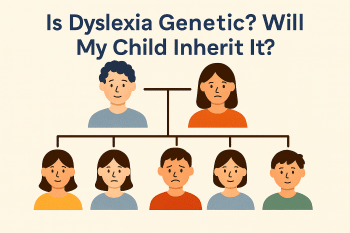
Is Dyslexia Genetic? Will My Child Inherit It?
“Deer momee and dadee… I canot reed.” With these heartbreaking words, a boy named David reveals the pain of dyslexia—and a question many parents ask: Is it inherited? This article explores the science of dyslexia’s genetic roots, the role of environment, and why early support can change a child’s future.
Read more...
Dyslexia and Reading Difficulties
The 3 Leading Causes of Dyslexia
The term dyslexia refers to persons for whom reading is simply beyond their reach. This article investigates the top three possible causes of dyslexia: genetic influences, cognitive deficits, and brain differences.
Read more...
Reading and Learning Research
Dyslexia and Short-term Memory
A study shows that adults with dyslexia present a deficit in core verbal short-term memory processes. This deficit cannot be accounted for by the language processing difficulties that characterize dyslexia.
Read more...
Reading and Learning Research
Brain’s Plasticity Reduced in People with Dyslexia
A distinctive neural signature found in the brains of people with dyslexia may explain why these individuals have difficulty learning to read, according to a study from MIT neuroscientists.
Read more...
Dyslexia and Reading Difficulties
Dyslexia Theories and Models
About dyslexia theories: the phonological deficit theory, magnocellular theory, rapid naming deficit, double deficit hypothesis, and the multiple deficit model that considers all the aspects that may contribute to dyslexia.
Read more...
Dyslexia and Reading Difficulties
Dyslexia: More than a Phonological Deficit
Most problems can be solved once we know what causes that particular problem. For example, a disease such as scurvy claimed the lives of thousands of seamen during long sea voyages. However, the disease was cured fairly quickly once the cause was discovered: a vitamin C deficiency. A viable point of departure would therefore be to ask the question, what causes dyslexia?
Read more...
Contact Us
We use cookies to ensure that we give you the best experience on our website. If you continue to use this site we will assume that you are happy with it.
Ok
Privacy policy